

This edition is a little different. It is not part of the six-part pre-acquisition series, and it is not a tightly focused deep dive into one concept. It is more personal and more open, a longer recap of where I’ve been over the last weeks as an aspiring acquisition entrepreneur, what I’ve been working on in the background, what I’ve learned about myself, and how that shapes the next steps for my HoldCo, for ETA Amsterdam, and for this newsletter itself.
From now on, I’ll be sending these broadcasts primarily through Kit, because it gives me a bit more space to experiment with structure and depth. I will still repost the essays on Substack, but I won’t be sending separate email blasts from there. Think of Substack more as an archive of my writing going forward, and Kit as the place where I send the letters in real time.
Today’s newsletter is a field report. It covers the last few weeks, the ETA conference in Rotterdam, my first public pitch, why the traditional search fund model is not for me, the emerging picture of the kind of business I want to buy, a new ETA project with Saxion University, the evolution of Buyout Diary and ETA Amsterdam, and some practical notes about meetups, sponsors and next steps.
It is long on purpose. This is where I connect the dots for myself as much as for you.
What The Last Weeks Actually Looked Like
If you could have followed me over the last month, you would not just have seen someone sitting behind a laptop writing conceptual pieces.
You would have seen long Google Meet calls with searchers and investors from the Netherlands, Germany, Greece, Spain and the UK. You would have seen me in conversations with people at very different stages of the ETA journey: some still in corporate roles, some already deep into ownership, some raising capital, some quietly admitting that they are unsure if they even want to run a company day to day. You would also have seen something less glamorous: a period of being ill, having to slow down, cancelling things, and then carefully rebuilding energy and focus.
Alongside that, there was a steady rhythm of reading, note-taking and thinking about my own path: what kind of business I actually want to acquire, what kind of owner I want to become, and how all of this interacts with the projects I am building around acquisition entrepreneurship like Buyout Diary, ETA Amsterdam, and my work as a mentor and advisor. It has been a mix of external motion and internal consolidation, of being “out there” and then processing what all of that really means.
These weeks did not look impressive from the outside in the way social media likes to present progress. There were no constant announcements, no endless stream of visible achievements. But they felt important. Because the work was less about doing more, and more about deciding which path I am actually willing to walk.
What I’ve Been Doing As An Aspiring Acquisition Entrepreneur
When you tell people you are working on acquiring a business, it can sound abstract. It sounds like something that happens on spreadsheets and in quiet negotiations. In reality, a lot of the early work looks like conversations, pattern recognition and personal calibration.
Over the last weeks, I have deliberately spent more time talking to people who are already ahead of me on this path: searchers who are midway through their journey, HoldCo founders who own multiple businesses, investors who have seen dozens of deals succeed and fail, and operators who run the companies acquirers buy. I asked them not only about structures and numbers, but about what their lives actually feel like. How they make decisions. Where they feel trapped. Where they feel alive.
These conversations were not always neat. They were full of contradictions and uncertainty. But that is exactly where the learning sits. What struck me is that most people are not stuck because of lack of information; they are stuck because of conflicting priorities, unclear identity, or fear of choosing one path and closing off others. In listening to them, I also heard myself more clearly.
At the same time, I continued to work on my own positioning. I refined my ideas about sector focus, about the size and type of business that fits my temperament, and about how I want to structure a HoldCo that can eventually own and govern several companies. And in between, I also had to accept that physical energy is not infinite. Being ill for a period forced me to reassess what is truly essential and what is just performative motion.
What I Learned About Myself In The Process
All of this has taught me more about myself than any framework could.
I realised that I have a strong need for autonomy and stewardship. I do not want to be a hired CEO in someone else’s structure, fully replaceable and reporting into investors who effectively control the business. I respect that model, but it does not fit who I am. I want to be the owner who sets direction, defines governance, and then brings in strong operators and general managers to run the day-to-day.
I also realised that my time preference is long. I am not in this for a quick exit or a narrowly defined IRR target. I want to build something I can hold and compound over time through a HoldCo, and I want the freedom to make decisions that are aligned with my philosophy of ownership, not just with short-term optimisation. That means I am willing to move slower at the beginning if it increases the quality and autonomy of what I eventually own.
And I learned that I get energy from building systems and communities around a topic, not only from doing the thing itself. That is why Buyout Diary, ETA Amsterdam and my upcoming work with Saxion University do not feel like distractions. They feel like the ecosystem around the core: acquiring, owning and stewarding a company.
Rotterdam: A Conference That Functioned As A Mirror
One of the key events in this period was the ETA conference in Rotterdam.
It was the sort of gathering where you immediately feel that most people in the room are carrying similar questions, just at different stages and with different intensity. There were searchers, investors, operators, advisors and academics. Although there were panels and structured sessions, I found the conversations that took place between them in the corridor, over coffee and in small groups to be the most valuable.
What struck me there was the gap between how clean and structured the idea of ETA looks on slides and how messy it feels in people’s lives. On stage, models are presented, playbooks are explained, case studies are shared. Off stage, people talk about anxiety, about their families, about doubts around leverage and risk, about their own capacity to lead teams in unfamiliar industries. It made me even more convinced that we need to talk about the human side of acquisition entrepreneurship as much as the mechanical side.
Rotterdam also gave me something else: a clearer mirror of my own preferences. Being surrounded by so many people leaning into the classical search fund model made me realise, almost by contrast, where I stand.
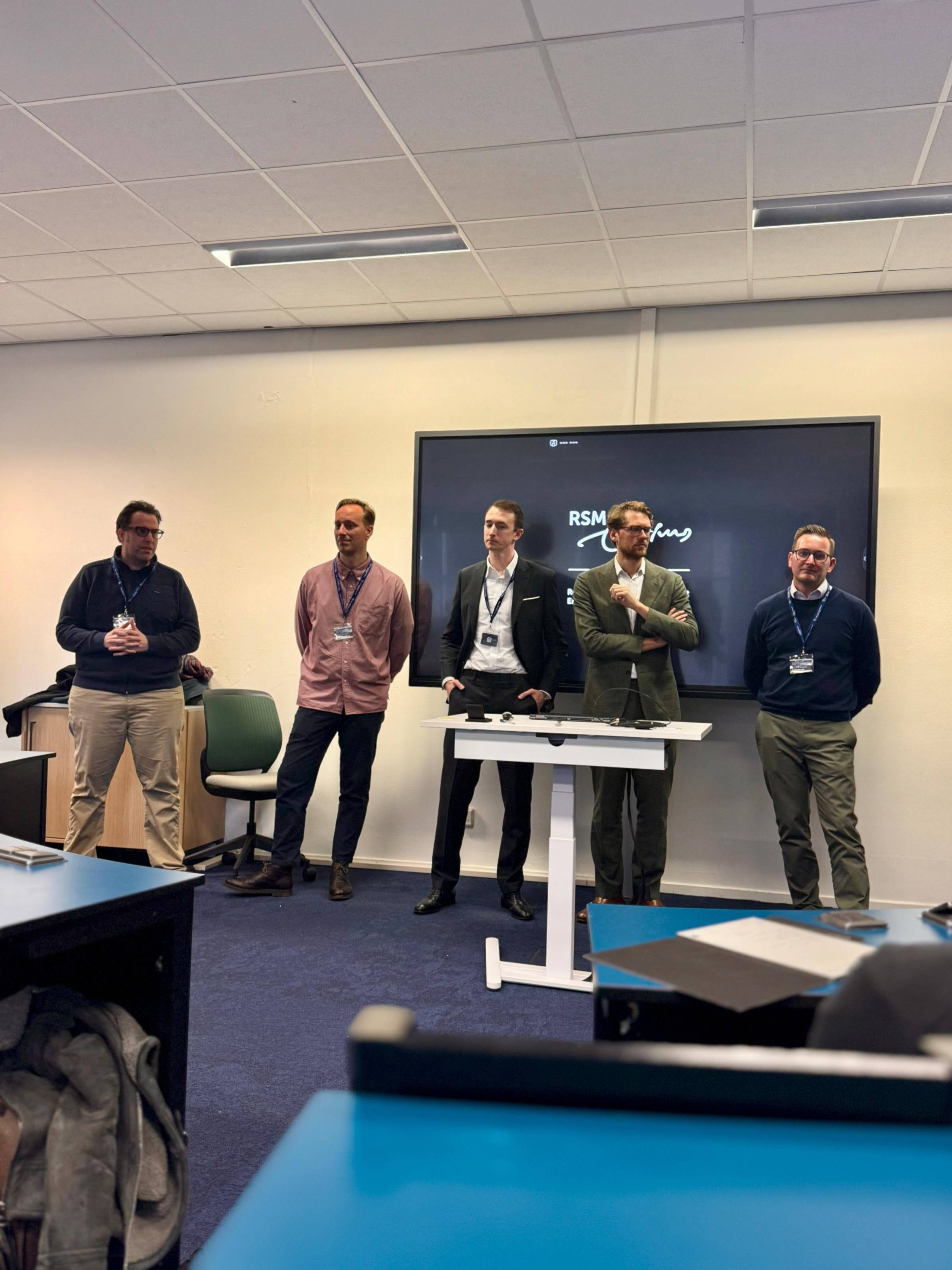
👉 Click to read my LinkedIn post
Why The Traditional Search Fund Model Is Not For Me
The conference helped me articulate something that had been in the background for a while: the traditional search fund model is not my path.
It is not that there is anything inherently wrong with it. It has created real successes and given many people a structured way into ownership. But when I look at my own temperament and philosophy of ownership, there are a few points of friction that I cannot ignore.
In the classical search fund model, you raise capital from investors before you even have a business. You search on their mandate. They pay you a salary during the search, and in return they receive control rights, preferred economics, and the ability, at least in principle, to replace you as CEO if things do not go the way they hope. Your ownership vests over time, and your position in your own company is, structurally, conditional.
For some people, that is exactly what they want: structure, mentorship, de-risked income, and a clear expectation framework. For me, it is the opposite of what I want. I don’t want my role as CEO to be something that can be quietly re-evaluated by a board according to a template. I want to be the principal and then invite partners and advisors into my structure, not the other way around.
I also know that I am more drawn to building a small, patient HoldCo where capital supports a long-term vision rather than dictates it. That means I prefer raising equity or forming partnerships deal-by-deal, with clear agreements, instead of entering a predefined governance structure designed for a generic searcher. Rotterdam made that clear enough that I could finally say it to myself without hesitation.
My First Public Pitch And The Business I Want To Buy
Rotterdam was also the place where I gave my first real public pitch.
Part of it was about ETA Amsterdam, which I’ll come to later. But part of it was about something more specific: the type of business I want to acquire first.
That moment, standing there and putting my direction into words in front of people who understand the space, made everything feel more concrete. It is one thing to have ideas in your notebook; it is another to expose them to the room and see how they resonate.
My focus has now crystallised on acquiring a small accounting firm in the Netherlands, ideally with around ten to twenty employees. Not a giant corporate practice, and not a purely one-person bookkeeping office, but something in between: a firm that is big enough to have a team and client base, and small enough to be personal, human and transformable.
My long-term vision is not to run it as a traditional accounting shop, but to slowly build it into a CFO-as-a-Service platform for small and medium businesses. A place where clients don’t just get compliance and bookkeeping, but also financial insight, guidance, and eventually, broader support around cash flow, planning and decision-making.
This is still a direction, not a signed LOI. But saying it out loud, in public, helped move it from “idea” into “path”.
A New ETA Project With Saxion University
Parallel to all of this, another project has been taking shape.
From January to April, I will be working with the Saxion University of Applied Sciences in Deventer, contributing to their Master programme with a project on Entrepreneurship Through Acquisition. The idea is to bring ETA into an applied academic context: to introduce Master’s students to the concept of buying a business as an entrepreneurial path, to discuss models and governance, and to connect theory with what is happening in the SME market.
This is important to me for two reasons. First, it forces me to articulate my understanding of ETA clearly enough that it can be taught, challenged and refined. Second, it lets me give something back into the educational context where I came from myself, but with the benefit of practical research and current conversations.
It is another example of how my journey is not only about buying a business, but also about building an ecosystem of knowledge and practice around the idea of acquisition entrepreneurship.
What The Six-Part Series Did For Me
The six-part pre-acquisition series I wrote recently is only one part of this broader picture, but it still played a role in shaping my thinking.
Writing about investment theses, deal sourcing, capital and financing, negotiation, due diligence and closing forced me to sit still and think in a structured way at a time when a lot was happening externally. It made me articulate things that I believed intuitively but had never written down. In that sense, the series was as much for me as it was for anyone reading.
What I realised through writing is that ETA is less about “learning a playbook” and more about deciding what kind of owner you are willing to become. The mechanics are important, but they are downstream of identity, temperament and values. That realisation has informed how I think about my own HoldCo and the way I want to raise capital and choose partners.
If you want to revisit the last two parts of the series:
👉 Part 5 – Due Diligence Beyond the Spreadsheet
👉 Part 6 – Closing the Deal and Entering Ownership
They reflect many of the themes I’ve been living through recently.
Where Buyout Diary Is Heading
Buyout Diary started as a simple idea: to document my journey into acquisition entrepreneurship in a more thoughtful way than a Twitter thread or a LinkedIn post ever could. Over time, it has become more than that. It has turned into my thinking space, a place where I process interviews, research and experiences, and occasionally package them into something that might be useful to others on a similar path.
Going forward, I still see Buyout Diary primarily as a long-form reflection hub, not a content machine. That is partly why I am shifting the sending mechanism to Kit, while keeping Substack as an archive. I want the freedom to write pieces that are perhaps too long for the current content culture but honest to where I am intellectually and emotionally.
I’d rather publish fewer, denser, more considered pieces than chase frequency for its own sake.
Why I’m Building ETA Amsterdam
Alongside writing and research, there is another pillar: ETA Amsterdam.
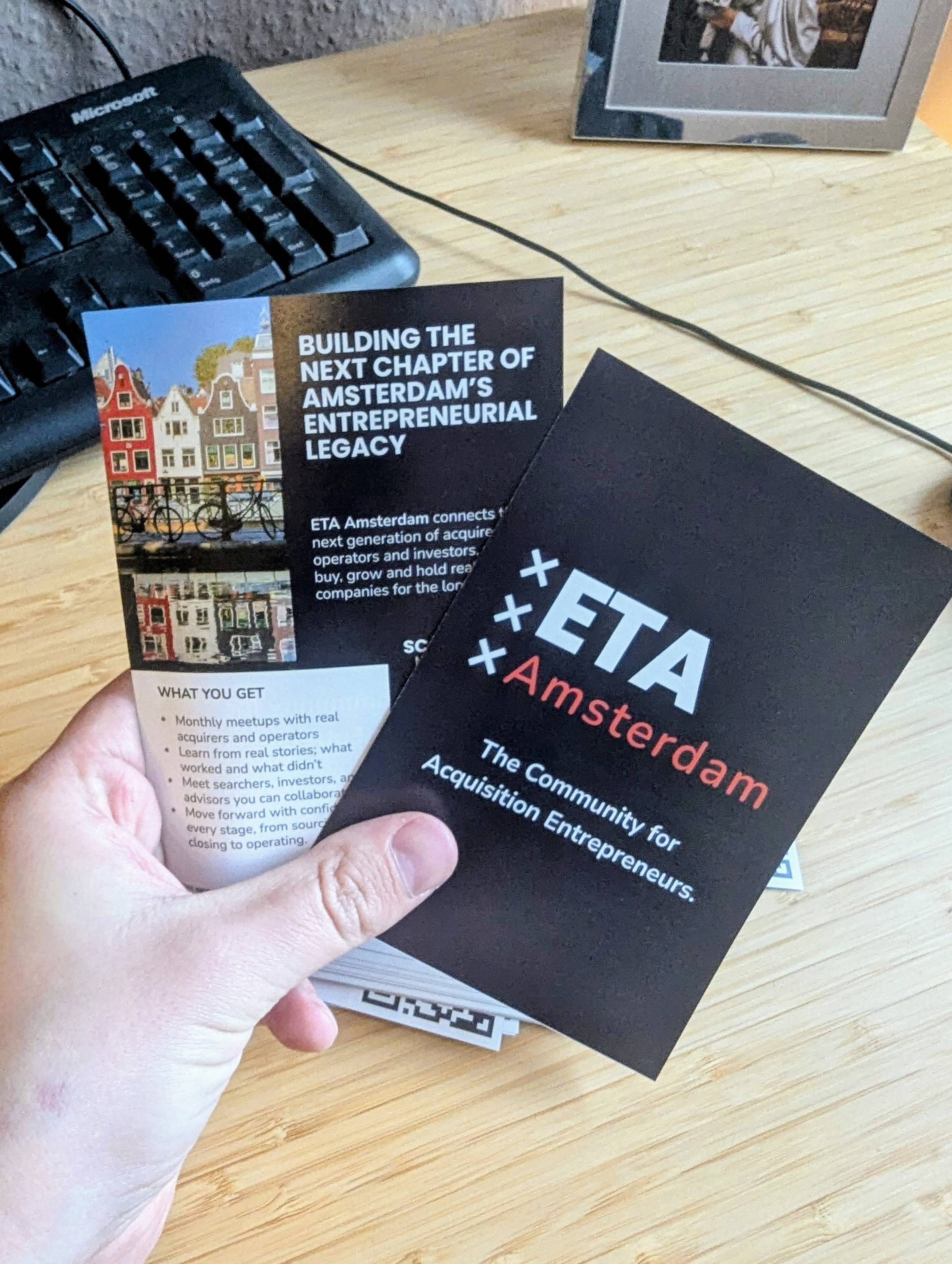
ETA Amsterdam exists because I could not find the kind of room I wanted to be in. There are conferences, formal events and networking spaces, but I wanted something more intimate and consistent: a community where acquisition entrepreneurs, investors, advisors and operators in this region can meet regularly, exchange openly, and slowly build relationships that matter.
The group has grown faster than I expected. We are now over 130 people in the wider circle, with around thirty who regularly attend in-person sessions. The conversations have started to shift from “What is ETA?” to “How are you structuring your deals?” and “What are you seeing in your sector?”, which is exactly the kind of evolution I hoped for.
My aim is not to make ETA Amsterdam huge. It is to keep it serious, warm and useful. A place where people feel they can say, “I don’t know,” just as easily as “Here is what I’ve learned.”
Founding Partners, Sponsors And Spaces
As the community grows, the practical side becomes more real.
I am now actively looking for a small group of founding partners and sponsors who want to help shape ETA Amsterdam in its early phase. Not just by contributing money, but also by helping with infrastructure: offering meeting spaces or offices in Amsterdam where we can host sessions, providing support for organisation, or opening networks that are aligned with the idea of building a serious acquisition entrepreneurship ecosystem in this part of Europe.
I am not looking for logo collections. I am looking for partners who understand that what we are building here is long-term and relationship-driven.
If you are reading this and feel that you or your organisation might be a good fit as a founding partner or sponsor, the easiest way is simply to reach out directly. Reply to this email or send me a message on LinkedIn, and we can have a conversation about what this could look like on both sides.
👉 Let’s talk!
A Practical Note On Meetup Contributions
With growth comes cost.
From January onwards, I will most likely introduce a €20 contribution per person for the ETA Amsterdam meetups. This is not about turning the community into a business. It is about covering very real costs: venue rental, equipment where necessary, organisational time, and making sure that the quality of the experience stays high as we move into more professional spaces.
Depending on the venue, it might sometimes be possible to include a first drink or some form of extra, but I do not want to promise something I cannot consistently control. What I can promise is that I will keep focusing on making these sessions worth your time, in terms of atmosphere, conversations and connections.
A contribution also has another effect: it creates a small but meaningful level of commitment. People who pay something, even a modest amount, tend to show up more intentionally. And I would prefer a room of twenty engaged people to fifty who are half-present.
👉 Updates and upcoming meetups → Join here
Where I Am Now And What Comes Next
Standing here now, I feel in a transitional space.
Some elements are much clearer than they were a few months ago: the type of business I want to acquire, the structure I want for my HoldCo, the models that fit me and the ones that do not, and the role I want Buyout Diary and ETA Amsterdam to play in this ecosystem. Other elements are still forming: the exact path to my first acquisition, the pace of capital raising, the timing of major decisions.
My focus for the coming months is relatively simple to state, even if it is complex to execute:
Continue building Buyout Diary as a place for deep reflection on ETA and ownership.
Grow ETA Amsterdam as a serious, sustainable community for acquisition entrepreneurs and partners in this region.
Sharpen and advance my own acquisition path in the accounting sector, including relationships with potential sellers, advisors and investors.
And from January to April, contribute to the Saxion University ETA project, which will further refine and test my thinking.
I am deliberately not rushing beyond that. The temptation in this space is always to announce more than you have actually grounded. I would rather move slower and in alignment than fast in ten directions.
Closing Reflection
These last weeks reminded me that there is a quiet but important difference between talking about change and actually living inside it.
Talking about change is clean. You can structure it, present it, package it in frameworks. Living inside it is messier. It involves doubt, recalibration, unexpected turns, and the humility to admit when a model or path does not fit you, even if it looks appealing on paper.
I am sharing all of this here not because it is perfectly polished, but because I believe that transparency about the in-between phases is as valuable as polished case studies about the end result. If you are somewhere on this journey yourself, and thinking about buying a business, already searching, or moving into ownership. I hope some of these reflections give you a sense of companionship, or at least a few useful questions to ask yourself.
Thank you for reading, and for walking alongside this process in whatever way you do.
Warm regards,
Alexander