

Most self-funded acquisition buyers hit the same wall.
The bank covers 60 to 70% of the purchase price. Personal equity covers another 10 to 15%. And then there is a gap. Not a fatal gap, but a real one. At that point most buyers do one of two things: they restructure the deal to need less capital, or they walk away.
The fear behind both choices is the same. Every story they have heard about bringing in outside capital ends badly. The investor gets a board seat. The investor gets veto rights. The investor gets preferred returns that mean the buyer is working for years before they see any meaningful upside. The buyer loses control of the thing they spent months finding and negotiating.
This issue covers the full capital stack for a self-funded acquisition, in the order that matters: bank debt, seller financing, government subsidies, and finally how to bring in a capital partner without handing over the keys.
You do not have to give up control to bring in an investor. Whether you give up control depends entirely on how you structure it.
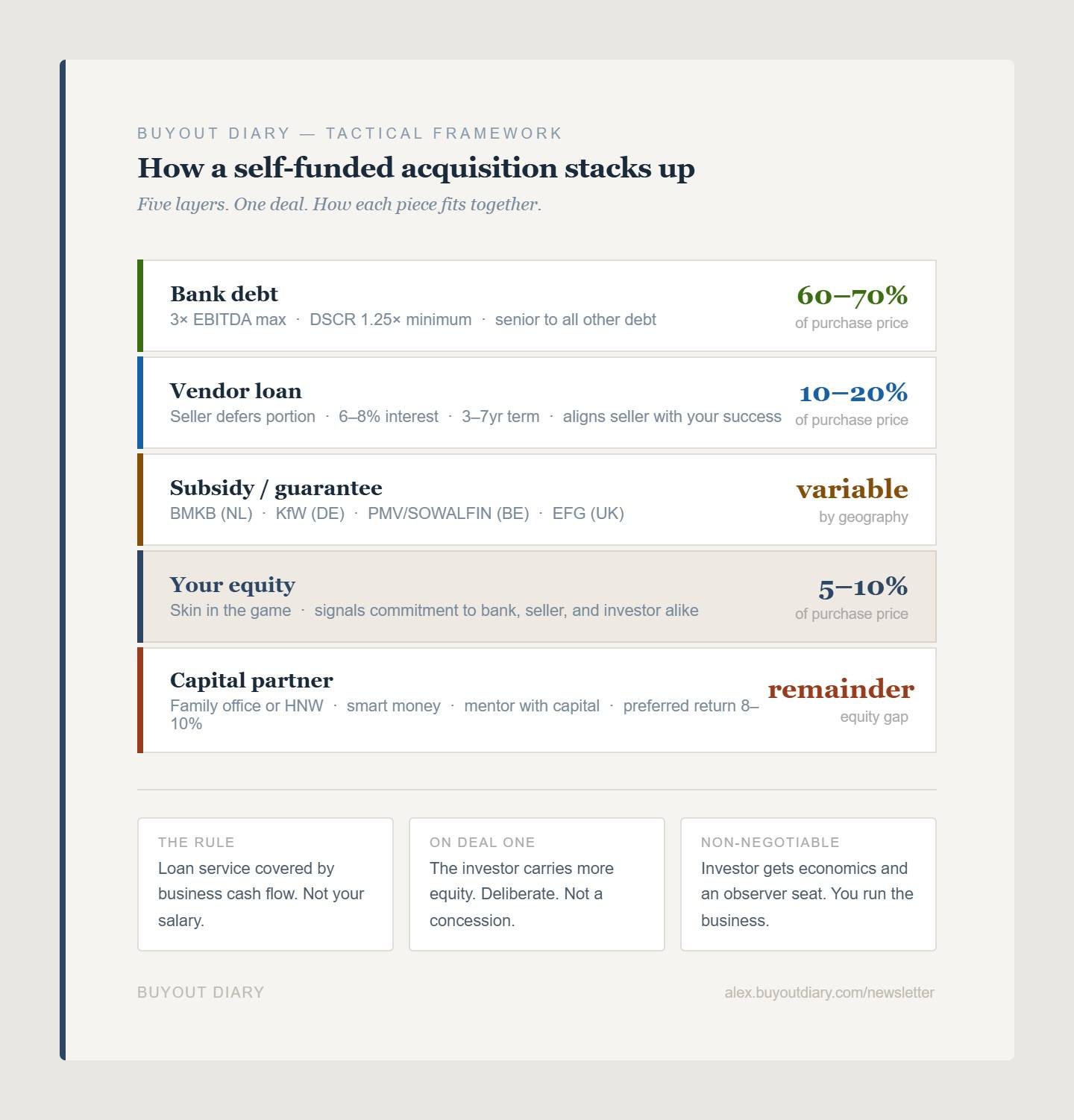
1. What the Capital Stack Actually Looks Like
Before covering the structures in detail, it helps to see what a typical self-funded acquisition capital stack looks like in practice.
For a business with €500,000 EBITDA acquired at a 4 times multiple, the purchase price is €2 million.
A commercial bank comfortable with 3 times leverage might lend €1.5 million against that EBITDA. That covers 75% of the purchase price.
Your equity requirement to close the remaining 25% is €500,000.
If you have €200,000 in personal equity, you have a €300,000 gap.
That gap can be filled by a seller note. Or an earn-out. Or an investor. Or some combination of all three. The question is which combination gives you the best outcome on control, alignment, and long-term economics.
Each tool has different implications for your relationship with the seller, your relationship with a potential investor, and your own position in the business. Understanding them is not optional. It is the difference between a deal that closes on your terms and a deal that closes on someone else’s.
2. Vendor Loan: The Seller Becomes Part of Your Capital Stack
A vendor loan — also called seller financing or a seller note — is an arrangement in which the seller agrees to defer a portion of the purchase price and receive it in instalments over time, effectively acting as a lender to the buyer. The terms are interchangeable. In European M&A practice, vendor loan is the more common label. In UK and US contexts you will hear seller financing or seller note. Same structure, different name.
It is more common than most buyers realise. According to Dealsuite’s M&A Deal Terms Report covering transactions from July 2024 to June 2025, based on data from 959 legal firms across Europe, 34% of European SME transactions included a vendor loan. And that number has been rising. The same research found that 42% of M&A advisors reported an increase in vendor loan usage in recent transactions, driven partly by higher interest rates making bank financing more expensive and partly by valuation gaps that need creative bridging.
In the UK, estimates suggest that between 60 and 90% of small business acquisitions include some form of seller financing. On the continent, the proportion is lower but growing.
Why sellers agree to it
The conventional wisdom is that sellers want all their money at closing. That is true for some sellers, particularly those with urgent liquidity needs or those who have received multiple competitive offers. But for many succession sellers across Europe, the picture is more nuanced.
A seller financing a portion of the deal at 6 to 8% interest is earning a better return than they would get from a savings account or low-risk bonds. They remain financially connected to the business they spent decades building, which many sellers find emotionally easier than a clean break. And because repayment depends on the business performing, they have a genuine incentive to support the transition. The vendor loan turns the seller from a counterparty into an aligned partner.
There is also a pricing dynamic that buyers rarely appreciate. Research in the US market consistently shows that businesses sold with seller financing sell for 20 to 30% more than businesses sold for all cash. The seller is not just agreeing to defer payment. They are agreeing to take on risk. And they expect to be compensated for it, either through a higher headline price or through the interest they earn on the deferred amount. Understanding this framing changes how you negotiate the structure.
How to structure it
A vendor loan typically covers 10 to 30% of the purchase price, repaid over three to seven years at an interest rate of 6 to 10%. It sits subordinated to senior bank debt, meaning the bank gets repaid first in a distressed scenario. Most banks require this subordination clause as a condition of their own lending.
The key terms to negotiate are the repayment schedule, whether interest is payable from day one or deferred, and what happens in the event of default. A seller who is comfortable with the buyer and confident in the business will often accept more flexible terms. A seller who is uncertain about either will negotiate harder.
One practical point that catches buyers out: some European banks count a vendor loan as part of the buyer’s equity contribution, which can reduce the amount of personal capital required at closing. In the Netherlands in particular, BMKB-guaranteed loans have specific provisions around how vendor loan subordination is documented. Get advice from a Dutch acquisition lawyer before assuming your structure will pass bank credit committee.
The trust signal
Asking a seller for vendor financing is also a conversation about trust. It signals that you believe the business is strong enough to generate the cash to repay them. It aligns their interest in your success. And it demonstrates that you are not simply extracting value from the business immediately after close. For succession sellers, many of whom care deeply about what happens to the business and its staff after they leave, that signal matters.
3. Earn-Outs: Bridging the Valuation Gap Without Overpaying
An earn-out is a deal structure in which a portion of the purchase price is contingent on the business achieving specific financial targets after the acquisition closes. The buyer pays a lower price at closing and makes additional payments if and when the business performs as the seller projected.
Earn-outs are most useful when there is a genuine gap between what the seller believes the business is worth and what the buyer is willing to pay based on historical performance. They allow both parties to proceed without one of them having to capitulate on valuation. The seller effectively says “I believe this business will hit those numbers” and backs that belief with their own deferred payment. The buyer says “if you are right, I am happy to pay for it.”
According to Dealsuite’s 2025 data, in more than half of European transactions that included an earn-out, the deferred portion represented 10 to 20% of the total purchase price. That is a meaningful but not dominant share, which reflects the practical reality that sellers want the majority of their proceeds at closing and earn-outs become psychologically uncomfortable if they represent too large a proportion of the headline price.
Where earn-outs work
Earn-outs work best in three situations.
First, where the seller has been running the business with an unusually high personal revenue contribution. If the seller is responsible for 40% of client revenue through personal relationships, the business as it will exist under new ownership is genuinely different from the business as it existed under them. An earn-out that pays the seller more if they successfully transition those relationships to the new owner creates alignment rather than conflict.
Second, where the business has a strong recent growth trajectory that is not yet fully reflected in normalised EBITDA. A business that grew revenue 30% in the last twelve months but has not yet translated that growth into stable profit may be worth more than the historical EBITDA multiple suggests. An earn-out tied to sustaining that growth gives the buyer downside protection if the growth proves temporary and rewards the seller if it proves durable.
Third, where there is a genuine difference of view on market conditions rather than a straightforward disagreement on multiples. Both parties can be right simultaneously: the seller is right that the business has significant potential, the buyer is right that the potential has not yet been demonstrated. The earn-out lets both views coexist in the same transaction.
Where earn-outs fail
Earn-outs fail when the metrics are ambiguous, when the seller retains operational involvement that gives them influence over the results, or when the buyer makes decisions post-closing that affect performance in ways the earn-out agreement did not anticipate.
The most common failure mode in earn-outs at the SME level is a seller who agrees to an earn-out tied to EBITDA and then watches the new owner invest in the business in ways that depress short-term profitability. The buyer is building for the long term. The seller is watching their earn-out shrink. That tension is predictable and must be addressed in the agreement before close.
Keep earn-out metrics simple, make the measurement period no longer than two to three years, and ensure that major capital decisions by the buyer during the earn-out period are either excluded from the calculation or subject to seller consent.
4. Bringing in an Investor Without Losing Control
Now to the structure most first-time buyers misunderstand.
The reason most buyers fear investor involvement is that they are picturing the wrong type of investor. They are picturing a private equity fund with a three to five year exit horizon, a board seat, quarterly reporting requirements, and a preferred return that subordinates the buyer’s economics for years. That investor exists, and for a buyer building a long-term HoldCo, that investor is the wrong partner.
The right partner for a first-time buyer is a family office, a high-net-worth individual, or a fellow acquisition entrepreneur with capital to deploy. These investors think in decades, not fund cycles. They do not need a formal exit event to generate returns. They are flexible on governance because they are investing in you as much as in the business. They are often motivated by genuine interest in the deal and the sector rather than purely financial return maximisation.
What you are doing when you bring in this kind of partner is straightforward: you source the deal, structure it, negotiate it, and bring it to close. You find someone to provide the equity you cannot provide yourself. You operate the business. They provide capital and, typically, some oversight. Both of you share in the upside. No fund structure, no PE overhead, no exit pressure from limited partners.
What the investor gets
The investor typically receives a preferred return of 6 to 10% on their invested capital before any profits are split. After the preferred return is met, profits are distributed according to an agreed waterfall. The buyer-operator retains 70 to 80% of the economics on deals where they are providing meaningful equity alongside the investor, and somewhat less on deals where the investor is carrying the majority.
The investor may also receive a board observer seat, and will typically negotiate consent rights over major decisions: taking on new debt above an agreed threshold, making material changes to the business, or selling the company.
What they do not get, in a well-structured deal, is day-to-day operational control. That remains with you.
Two negotiations, not one
The most important thing to understand is that two negotiations are happening simultaneously. The negotiation with the seller and the negotiation with your investor. Both need to close. Neither should be subordinated to the other.
The conversation with your investor should happen early. You want to arrive at the seller’s table with a credible sense of your capital structure, not an open question about whether you can fund the deal. The earlier you have that conversation, the more flexibility you have to structure the deal in a way that works for both of you.
Before you approach any investor, have a clear answer to four questions. How much equity do you need from them? What governance rights are you willing to offer in exchange? What return structure are you proposing? And what is your plan for the business in years one, three, and five?
Why family offices work well here
Family offices are particularly well-suited as capital partners for acquisition buyers at this stage. They have long investment horizons that match a HoldCo model. They are comfortable with minority or co-investment positions. They do not impose the same exit pressure as institutional PE. And many family offices are themselves business-owning families who understand the operational reality of running a founder-led business.
The trust dynamic matters here. A family office investing in your acquisition is not just providing capital. They are extending their reputation alongside yours. Getting that first relationship right creates the foundation for every subsequent deal in your portfolio.
5. How I Am Thinking About My First Acquisition
I want to be honest about where I stand, because I think it is more useful than a theoretical framework.
I have not closed a deal yet. My first acquisition attempt did not happen for reasons unrelated to the structure, that is a story for another issue. But the capital stack I am planning for when the right deal comes is worth sharing, because I suspect the logic applies to a lot of people reading this.
On my first acquisition, my investor will carry a larger share of the equity than I will. That is not a reluctant concession. It is the deliberate structure I am planning for.
I have €100,000 of personal capital to put into a deal. I want bank debt to do the heavy lifting on the debt side, with the monthly loan service covered by the business’s own cash flow. I want a vendor loan from the seller where I can get one, because it aligns their interest in my success and reduces the equity I need to raise. I am actively looking at subsidy instruments in my target geographies to back the bank loan or bridge part of the gap. And after all of that, I will still need an investor to close the equity stack on most deals I am looking at.
One point worth adding here: the bank also wants to see your personal equity in the deal. It is not just about reducing the gap. It is a signal. A buyer with zero skin in the game is a different credit risk from a buyer who has committed their own capital alongside borrowed money. Most banks will not lend at all without seeing meaningful personal equity from the buyer. So your €100,000 is not just filling part of the stack. It is what makes the rest of the stack possible.
The investor I am looking for is not a passive cheque. I want smart money. Someone who has been through acquisitions before, who understands the succession market, who has opinions I can pressure-test my decisions against. A mentor with capital is worth more to me on deal one than a purely financial investor who is only tracking their preferred return.
In exchange for their capital and their involvement, that investor will receive a meaningful share of the economics. On a first deal where they are carrying most of the equity, that share will be larger than it would be on deal two or three, when I have a track record and can bring more of my own capital. That is the honest trade. I am paying for their capital and their experience with equity I would otherwise keep.
What I am not giving up is operational control. I run the business. I make the day-to-day decisions. I decide on strategy, on people, on how we operate. The investor has an observer seat. They have consent rights on major structural decisions, taking on significant new debt, selling the company. They do not run the business. That line is non-negotiable regardless of the equity split.
The reason I am comfortable giving up more economics on deal one is simple. A smaller share of a deal that closes is worth more than a larger share of a deal that never happens. And beyond the economics, the relationship with the right investor on deal one is one of the most valuable assets I can build going into deal two.
That is the structure I am building towards. The exact numbers will depend on what I find. But the logic is fixed.
6. A Worked Example: How the Structures Combine
Take a business generating €400,000 EBITDA, acquired at a 4.5 times multiple, for a total purchase price of €1.8 million.
A German regional bank, comfortable with a DSCR of 1.3 times and leverage of 3 times EBITDA, lends €1.2 million. That covers 67% of the purchase price.
The seller agrees to a vendor loan of €180,000, representing 10% of the price, repayable over five years at 7% interest. Subordinated to the bank debt, documented with a standstill agreement.
That leaves €420,000 in equity required to close.
The buyer contributes €120,000 of personal equity, roughly 7% of the purchase price.
A family office investor provides the remaining €300,000. In exchange, they receive a preferred return of 8% per annum on their €300,000 before any profit distributions, a single board observer seat with no voting rights, and consent rights over debt above €100,000 and any sale of the business. After the preferred return is met, profits split 75% to the buyer-operator and 25% to the investor.
The result: the buyer controls the business. The seller is aligned through the vendor loan. The investor has appropriate protection without day-to-day interference. The bank has its DSCR and its subordinated debt structure. Everyone’s interests point in the same direction.
This is not a theoretical structure. Variations of this model are closing every month across the continent.
7. The Conversation to Have Before You Need It
The most common mistake buyers make is waiting until they have a deal under LOI before having the investor conversation.
By then you are under time pressure. You are negotiating from weakness. And the investor knows it.
The right time to build the investor relationship is before you need the capital. Identify two or three potential investor partners in the next six months. Have the conversation about your acquisition strategy, your target sectors, your deal thesis, and your governance philosophy. Understand what they need in return. Build the relationship before there is a specific deal to discuss.
When the right deal arrives, you will be able to move quickly because the conversation will already be half complete.
Hit reply and tell me: what feels harder to you right now, finding the right deal or finding the right capital structure to close it?
I read every reply.
See you next Monday. Alexander