

Here is the question every reader of this piece is asking: is the traditional search fund the right model for me?
The models series starts with this piece because in the academic ETA world, the traditional search fund is the number one model. Stanford, IESE, INSEAD, LBS, and Oxford have all organised their teaching around it. Every case study starts here. Every research paper cites it as the reference.
In the actual European ETA world, it is one model among many. Self-funded is more common. Independent sponsor is growing faster. HoldCos and committed capital vehicles now compete for the same searchers. Both statements are true, and holding both is the whole editorial point of this piece.
This issue answers the seven questions the intro promised: what the model is, what it costs, who it fits, who it does not, where it works in Europe, how it fails when it fails, and the honest downside. By the end, you should know whether the traditional search fund is the right model for you.
What the model is
The traditional search fund follows a four-stage lifecycle that Stanford has formalised over forty years and that Yale’s European reference guide has now translated into European legal and economic norms.
Stage one: raise search capital. The searcher raises a small pool of capital (in Europe, typically €300,000 to €700,000) from a syndicate of ten to twenty investors. Each investor buys “units” at €25,000 to €40,000 each. The capital funds the search itself: the searcher’s salary, travel, target identification, initial diligence, legal fees, and broken deal costs.
Stage two: search. The searcher spends 18 to 24 months looking for a target. Most searchers set criteria at the start (revenue range, EBITDA margin, sector, geography, growth profile) and refine them over time. The search ends when the searcher signs an LOI on an acquirable business.
Stage three: raise acquisition capital. With a signed LOI, the searcher returns to the original investors to raise acquisition equity. Investors have a right of first refusal and can participate at their pro rata share. Any equity not taken by original investors is offered to new investors. Debt (bank loans, seller notes) fills the rest of the purchase price.
Stage four: operate and exit. The searcher becomes CEO immediately after close. Typical hold periods are five to seven years. The searcher’s equity vests over time and performance, so the wealth creation happens at exit.
The economics
Every number below comes from the Yale School of Management European Search Funds Reference Guide (Rilling, Webster, Bransden, Wasserstein 2023). If you plan to explore this model seriously, that document is the best European reference available.
The 50% step-up. Search capital is treated as high-risk, so it earns a 50% step-up when it rolls into acquisition equity. Every €25,000 unit in the search phase becomes €37,500 of acquisition equity. This premium compensates investors for backing the searcher before there is a target.
Searcher equity. Solo searchers can earn up to 25% of the common equity. Partnered searches up to 30%. This equity vests in three tranches: one third at acquisition, one third over four to five years of time-based vesting, and one third based on performance.
The performance hurdle. The performance tranche vests only if the pre-tax IRR to investors exceeds 20%. It vests on a sliding scale up to full vesting at 35% IRR. If the fund achieves 27.5% IRR, the searcher earns half of the performance tranche. If it hits 35% or higher, the searcher earns the full amount.
Investor structure. Investors hold 70% to 75% of the common equity through preferred instruments (preferred equity or shareholder loans) with a 1x liquidation preference and typically an accrued dividend or interest. On exit, investors are paid back first, then a catch-up to the searcher, then distribution according to common shareholdings.
Governance. A formal board of three to five members (excluding the searcher) is established at acquisition. Board members receive fees. Certain decisions require investor approval. Quarterly reports go out within 30 days. Annual reports within 60 to 90 days.
Numbers vary by country and negotiation, but this is the standard European architecture. Deviating from it creates friction with investors who have seen the model many times.
Who does the model fit
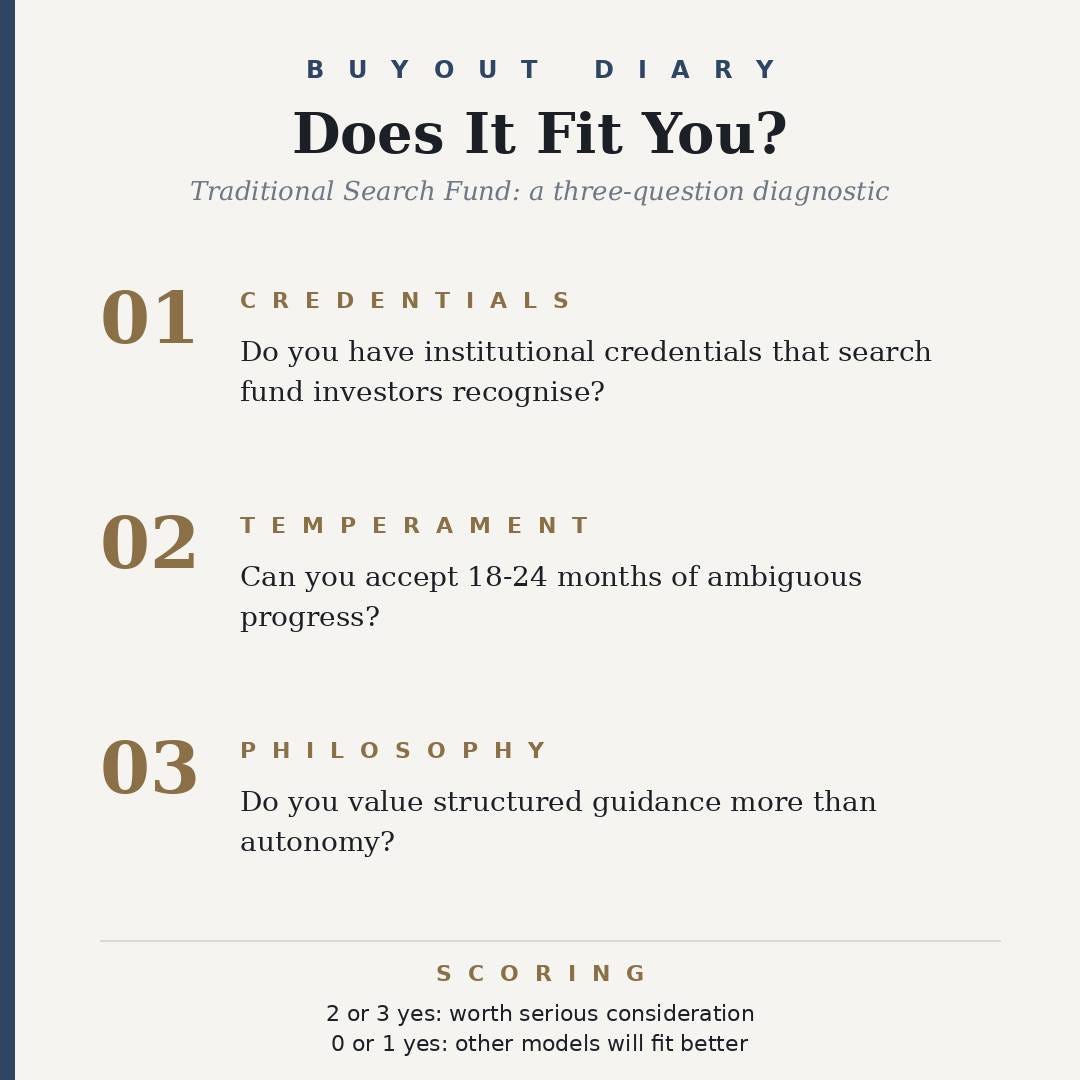
Three questions determine whether the traditional search fund fits you. Not credentials. Not ambition. Whether you can answer yes to at least two of these three.
The traditional search fund exchanges equity for infrastructure. You give up ownership to gain a system: capital, structured mentorship, an experienced board, and access to a decade-old ecosystem of investors, lawyers, and peers who have done this before.
Question 1: Do you have institutional credentials that traditional search fund investors recognise?
Stanford 2026 shows 80% of US search fund entrepreneurs hold MBAs. The IESE International 2024 study finds similar numbers internationally. The credential does not have to be from a top-ten school, but it does have to signal that you have been through structured training in strategy, finance, and general management. If you graduated from Stanford, IESE, LBS, Oxford, INSEAD, Chicago Booth, or Harvard, the traditional search fund infrastructure will welcome you. Elsewhere, you can still raise, but the friction increases.
Stanford’s cohort data adds nuance. Searchers with two to five years of post-MBA experience achieve a 55% acquisition rate versus 40% for those searching immediately after their MBA. Some post-MBA seasoning helps. Backgrounds in consulting (19% of searchers), PE (18%), and investment banking (15%) fit the model because they align with the analytical work of the first two years.
Question 2: Can you accept eighteen to twenty-four months of ambiguous progress?
The search phase is long, isolating, and unrewarding until acquisition closes. There are no wins to celebrate. There are hundreds of dead-end conversations, dozens of rejected LOIs, and few external validators. Searchers who need frequent feedback loops struggle here.
This is the temperament test. It matters more than credentials. Eighteen to twenty-four months of uncertain progress can put pressure on your judgement, especially when your runway is shrinking. I would ask myself whether I can keep rejecting the wrong deal when I am tired of searching. If you have thrived in structured, feedback-rich environments, the search phase may be harder than your credentials predict.
Question 3: Do you value structured guidance more than autonomy?
This is the philosophical test. The traditional search fund exchanges equity dilution for a network of experienced investors who provide mentorship, deal reviews, and post-acquisition support. Searchers who value that structure trade equity for it willingly. Searchers who value autonomy over guidance go self-funded, independent sponsor, or HoldCo.
There is no right answer here. Both preferences are legitimate. But choosing well requires knowing which you actually prefer, not which sounds better on paper.
The self-diagnostic. Two of three yes: the traditional search fund is worth serious consideration for you. One or zero yes: other models in this series will fit better. If you scored one, note which question you failed. That answer often points to the model that suits you.
Who the model does not fit
Personal fit matters here as much as structural fit. Not every searcher can handle the reality of investor oversight, and not every searcher wants to.
Experienced entrepreneurs with capital. Those who have already built and exited a business often prefer self-funded or HoldCo structures because they value autonomy and want to own more of the outcome.
Those wanting to move fast on a specific opportunity. The traditional search fund is designed for a broad search with predefined criteria. Searchers who have already identified a target through their network, or who see a time-limited opportunity, are better served by independent sponsor or self-funded structures.
Those searching in nascent ETA ecosystems. Freiling and Oestreich’s 2022 study of the search fund model in Central Europe identifies structural barriers in German-speaking markets: lack of awareness, cultural preference for family-internal succession, competition from small-cap family offices, well-established alternative financing (KfW, Bürgschaftsbank, seller notes, house-bank debt), and a weaker MBA culture.
Those seeking smaller deal sizes. Traditional search fund investors expect target enterprise values large enough to make the fund economics work. Below roughly €5 million enterprise value, the structure loses its logic, and self-funded or independent sponsor paths become more efficient.
There is one more downside that deserves its own paragraph.
The Bad Leaver risk. Yale’s European reference guide describes a provision under which a searcher removed as CEO can lose both vested and unvested shares, with those shares called at a minimal value. The circumstances that trigger this outcome are defined in the actual shareholder agreement. That makes the wording of the leaver provisions one of the most consequential parts of the deal to understand before signing. The risk is real, but the precise outcome depends on the terms you negotiate and the reason for your departure.
Where it works in Europe
The country-level acquisition figures below need to be read against the study and period that produced them:
Spain: 59 acquisitions
United Kingdom: 17
France, Germany, Italy: 15 each
Poland, Netherlands: 5 each
Spain leads by a wide margin. The reasons are structural.
Ecosystem matters more than opportunity. IESE Barcelona has built a mature ETA programme over more than a decade, with an active International Search Fund Center, formal training, a dedicated investor community, and annual conferences. The infrastructure supports the model. In the UK, LBS and Oxford have built similar (though smaller) ecosystems. INSEAD anchors the French traditional search fund community.
Germany has a different starting point. The traditional search fund has less established institutional infrastructure there than in Spain. Searchers also work within a long-standing SME succession market with other financing routes and a different vocabulary for external acquisitions.
Culture matters. Spain has developed a succession business culture over the past twenty years. Family firms increasingly accept external buyers as legitimate. In Germany, cultural preference for family-internal succession remains stronger, and where owners do accept external buyers, they often prefer self-funded acquirers because that pathway feels more direct and less institutional.
Alternative financing matters. Alternative financing matters. German acquisition candidates may be able to combine personal equity, bank debt, seller financing and, where eligible, public loan or guarantee programmes. Those instruments can make a self-funded acquisition viable for some searchers. Their availability and terms depend on the borrower and the deal; they do not simply replace €5 million of acquisition equity.
The reading for European searchers in 2026: if you are searching in Spain, the traditional search fund is a proven model with real infrastructure. In the UK and France, it works with the right MBA credentials and network. In Germany, Austria, Switzerland, and most of Central Europe, self-funded and independent sponsor paths tend to fit better. The model still exists there, but it is uphill.
How the model fails when it fails
Two research streams help here. IESE Professor Jan Simon’s 2026 study, published as “Why some search fund acquisitions fail and how to prevent it,” identifies six causes of value destruction. Yale’s When to Give Up on Your Search Fund Dream (Littell, Rosner, Wasserstein 2023) examines a narrower question: when investors and a CEO should consider selling an underperforming business after acquisition..
The six causes of value destruction (Simon 2026):
The seller does not fully disengage. The former owner stays involved after transaction, undermines the new CEO, second-guesses decisions.
The CEO cannot lead effectively. Post-MBA management skills are theoretical. The transition to actual CEO of an operating business is harder than most searchers anticipate.
The board lacks leadership. A supportive culture toward the entrepreneur can lead to insufficient oversight.
Customer concentration. One or two customers accounting for most revenue creates existential risk.
Exposure to disruptive industries. Search fund CEOs tend to move cautiously. In fast-changing sectors, cautious moves become losing moves.
Government intervention. Regulatory changes, subsidy removals, price controls can disrupt the business economics.
The first three sit inside the model itself. Post-acquisition governance is where many traditional search funds fail, which connects directly to the research covered in Issue 8 on post-acquisition governance.
The three-to-five year threshold (Yale). The Yale paper analyses 67 search fund operating companies. Of 23 identified as early weak performers, only 39% (nine companies) chose to exit early. The nine that exited early achieved a 19% simple average IRR. The fourteen that held on delivered negative 9% IRR on average.
The conclusion is uncomfortable. Search fund CEOs and investors are structurally biased to hold underperforming businesses too long. Combined with Stanford baseline data (34% of searchers never acquire; 27% of those who acquire destroy wealth), roughly half of all traditional search fund attempts do not create value.
The honest downside
The model works, at scale, in the ecosystems that have built infrastructure around it. Stanford’s aggregate returns (33.9% IRR, 4.75x ROI in the 2026 study) prove that the top of the distribution delivers meaningful wealth. IESE International 2024 confirms similar patterns outside the US.
But the returns are heavily concentrated. Excluding the 10x-plus funds drops Stanford’s aggregate ROI to 2.8x and IRR to 27%. Excluding the top 10% drops ROI to 2.1x and IRR to 20%. Most searches produce modest returns or losses, and a small number of very successful funds carry the aggregate.
The traditional search fund is a lottery ticket with a manageable downside for the investor (who holds a diversified portfolio of searches) and a career-defining outcome for the searcher (who has only one search). The asymmetry cuts both ways.
For European searchers considering the model in 2026, the honest reading is this: the model is a genuine option if you fit the searcher profile, have the ecosystem access, and accept both the Bad Leaver risk and the investor oversight. Those circumstances are narrower than most searchers assume.
If you fit them, the model is well-supported and well-documented. If you do not, the other models in this series may be more relevant to your situation.
What you can do this week
Three actions scaled by ambition.
Smallest step. If you are considering a traditional search fund, download the Yale European Search Funds Reference Guide. Read the fifteen legal elements. Compare them against the deal terms you have been offered or expect to negotiate. Anything materially different from the norms in that guide is worth flagging with an experienced search fund lawyer.
Bigger step. Score yourself against the three questions in the “who fits” section above. Institutional credentials, tolerance for ambiguous progress, and preference for structured guidance over autonomy. Two or three yes means the model is worth serious consideration. One or zero yes means other models will fit better. Reply and tell me which question you failed, so I can shape the how-to-choose piece at the end of the series.
Boldest step. If you are searching in Germany, Austria, Switzerland, or Poland, read Freiling and Oestreich’s 2022 paper on search funds in Central Europe. It is one of the few honest academic assessments of why the model has not taken root in the region. Compare their findings to your own market observations, and use that comparison to sharpen your own model choice.
Close
The traditional search fund is the reference model. Every subsequent piece in this series will compare against it. Self-funded searchers give up structured capital in exchange for autonomy. Independent sponsors flip the raise sequence. Sponsored searches concentrate the relationship with a single backer. Accelerator-backed searches trade equity for playbooks. CCVs, LDEs, and HoldCos change the duration and portfolio ambition entirely.
Each of those adjustments makes sense only against the reference. That is why we started here.
Next Monday: self-funded search. The model most European searchers actually end up in.
Alexander
This is a great piece of research, Alexander. I really like how you focused on the European ETA space and not just overlaid the US perspective. For me, it summarises really clearly not only the characteristics of the model but also the “watch outs”. I am looking forward to the write ups of the other models.