

One of the most exciting things about exploring acquisition entrepreneurship is discovering the different ways people choose to scale. Some acquirers are content to buy a single company and hold it for life. Others prefer to sell within a few years and start again. And then there’s a model that sits somewhere in between: the roll-up strategy.
It’s a term that often gets thrown around in private equity or investment banking circles, but it has real implications for acquisition entrepreneurs too. Over the past weeks, I’ve been thinking a lot about what roll-ups mean in practice, where they fit into my own vision, and what lessons I can learn from those who’ve done it before. Today’s broadcast is my attempt to put those thoughts into words.
Why Roll-Ups Caught My Attention
When I imagine myself building a HoldCo, I don’t see it as just owning one stable business. My long-term goal is to build platforms in fragmented sectors where small operators struggle to compete alone. That’s exactly where a roll-up can make sense.
Think about industries like HVAC, roofing, truck repair, or even vending and micro-markets. They are highly fragmented, often run by family owners, and yet they provide essential, recurring services. They are also businesses where reputation and trust matter just as much as efficiency.
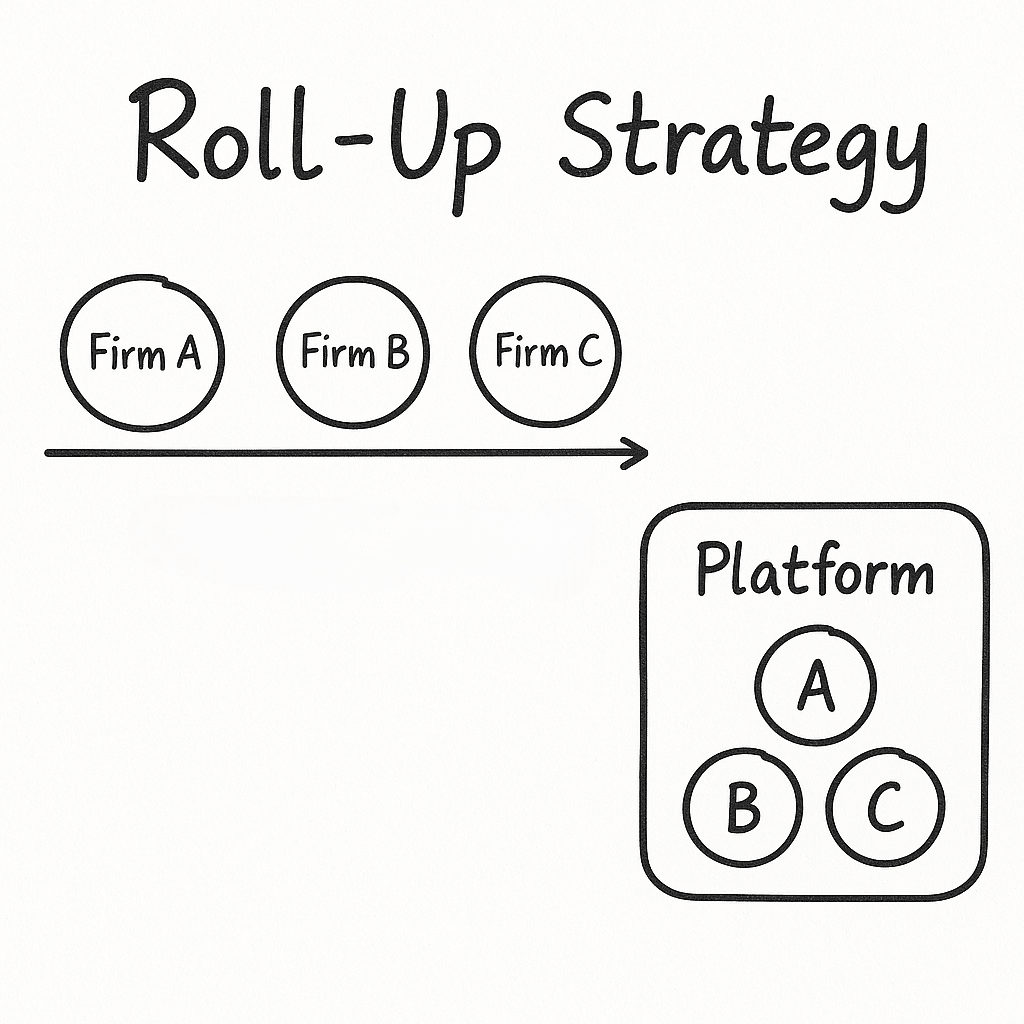
Here’s the appeal: if you acquire a solid platform company with established infrastructure, supplier contracts, and a workforce already in place, you immediately create a base. From there, you can start adding smaller bolt-on acquisitions. These are often at lower valuations because they are businesses that are too small to attract larger buyers. Over time, the bolt-ons benefit from the platform’s systems, and the platform benefits from increased scale and bargaining power.
I often use the vending machine example when I explain this to friends. Imagine you buy a business with 30 routes across a region. It’s not glamorous, but it has distribution, supplier relationships, and predictable cash flow. That’s the platform. Now imagine you add five more routes from smaller owners retiring. The cash flow from your base company finances the expansion, and suddenly you’ve created a much larger player without relying on personal guarantees or complex debt. That’s the power of a roll-up.
What Makes Roll-Ups Difficult
Of course, it’s not as simple as “buy more businesses, get bigger.” Roll-ups come with real challenges. Integration is the most obvious one: aligning teams, systems, and cultures can quickly become overwhelming if you scale too fast. Financing is never straightforward. The real challenge is not just finding capital. It’s also about finding the right capital. This means finding investors who can do more than just write a cheque.
And then there’s culture. Buying five companies in the same city is one thing; buying five across different European regions is another. Values, languages, and work cultures don’t always mesh neatly, and without alignment, even a promising roll-up can collapse under its own weight.
For me, these challenges are a reason to treat roll-ups with caution. I am drawn to the idea, but I also know I don’t want to start there. My instinct is to begin deal by deal, learn from each acquisition, and only then decide whether to pursue a roll-up path.
Lessons from Practice
During my MBA research interviews, I had the chance to speak with John Cerasuolo, the co-founder of LEAP Partners, an HVAC, and plumbing HoldCo in the U.S. South-East. John has built exactly the kind of roll-up machine many acquirers dream of.
One of his most important lessons was this:
“It’s not about how many companies you buy. It’s about whether they can fit under a common operating model.”
In other words, it’s not deal volume that makes a roll-up successful. It’s discipline. Standardising systems for finance, reporting, and culture early on is what creates the foundation for sustainable growth. Buy ten companies without integration, and you’ll be overwhelmed. Buy steadily, integrate properly, and scale with purpose, and you have something powerful.
John shared much more about this in a public interview, which I highly recommend if you want to go deeper.
👉 You can watch it here: How to Build a Roll-Up Machine.
My Personal Reflections
So where does this leave me?
I see roll-ups as a tool, not a starting point. The strategy resonates because of the sectors I’m drawn to: fragmented, succession-heavy industries in Europe that need patient owners willing to consolidate responsibly. But at the same time, I know the risks of trying to run before I can walk.
Europe is not the United States. Financing is more fragmented, cultural integration is harder, and many small sellers are sceptical of private equity-style approaches. That makes it even more important to build credibility one acquisition at a time.
In the long run, I could imagine using roll-ups inside my HoldCo structure as a way of scaling in selected industries. But right now, my focus is on clarity, discipline, and building a solid foundation first.
Further Reading
If you’d like to explore some of my earlier writing related to ETA more broadly:
👉 The Independent Sponsor Model shows entrepreneurs how to raise capital deal by deal without using a traditional fund.
👉 Why Every Acquisition Entrepreneur Should Think About Digital Business, and why even traditional buyers should consider digital assets as part of their portfolio.
Both explore the question of how acquisition entrepreneurship can be approached from different angles, and how you can shape a model that fits your personal vision.
Closing Reflection
Roll-ups are exciting, but they are not silver bullets. They require patience, discipline, and cultural sensitivity.
For me, this strategy is part of the bigger picture, but not the first chapter. I want to begin with single acquisitions, refine my governance approach, and build strong foundations before thinking about stitching multiple businesses together. In other words: walk first, then run.
But I also believe roll-ups can be powerful when done right. In fragmented markets, they preserve businesses that might otherwise close, give employees continuity, and create stronger players in industries that desperately need consolidation. In that sense, they’re not just about financial engineering; they’re also about stewardship, legacy, and resilience.
That’s why I keep roll-ups firmly in my long-term vision.
And now I’d love to hear from you:
Would you consider pursuing a roll-up strategy in your sector?
Or do you think it’s better to focus on one strong business at a time?
Hit reply. I’d genuinely love to hear your perspective. I’d also love to hear about your own experiences.
Warm regards,
Alexander