

In the world of acquisition entrepreneurship, we often talk about deal sourcing, valuations, and structures. But behind all of that, there’s a quieter truth that shapes whether an acquisition succeeds or slowly falls apart: the relationship between the owner and the operator.
Because no matter how sharp your spreadsheet is, how clever your structure looks, or how much capital you’ve raised once the deal closes, your success depends on one question: Who runs the business, and how do you lead them?
That’s what today’s broadcast is about. Not just hiring. Not just delegation. But the mindset shift from being the “acquirer” to being the owner-leader, the one who sets the tone for everything that follows.
The Mirror of Ownership
When you acquire a company, especially a small one, there’s a moment right after the closing papers are signed when reality hits: you now control something living, breathing, and full of people.
And here’s what many first-time acquirers discover the hard way, which is that the operator you hire (or the one you choose to keep) will reflect the kind of owner you are.
→ If you’re insecure, you’ll hire someone you can control.
→ If you’re thoughtful, you’ll hire someone who complements your weaknesses.
→ If you’re long-term oriented, you’ll find someone patient enough to grow with you.
It’s not about finding “the perfect CEO”. It’s about understanding yourself well enough to know what kind of leadership you’ll empower once you’re no longer in the building every day.
The Founder’s Dilemma Reversed
In traditional entrepreneurship, founders build from scratch. They’re hands-on, immersed in every detail. But acquisition entrepreneurs buy something that already exists. They buy a machine that runs. It may run imperfectly. But it still has deep founder DNA imprinted across every corner.
The challenge isn’t to build it from zero, but to step into stewardship.
That’s a different skill entirely.
You’re not the “hero” any more. You’re the architect of governance.
This is where the Founder’s Dilemma flips. Founders struggle to let go of control; acquirers struggle to define the right level of control.
→ Should you stay involved in operations, or step back?
→ Should you let the new CEO make mistakes, or intervene early?
→ Should you replicate your old playbook, or let the business teach you how it works?
Most acquirers underestimate just how psychological this transition is. In interviews, I conducted, almost every HoldCo founder said the same thing in different words:
“At first, I thought delegation was about tasks. Then I realised it’s about trust.”
That’s the moment where ownership becomes leadership.
The Operator Fit Framework
Finding an operator isn’t like hiring a manager.
It’s closer to finding a business partner, someone who will turn your investment into reality.
And yet, too many acquirers make the same mistake: they rush the process. They see competence, confidence, and a clean CV and assume it’s a match. But operator fit is not about credentials, it’s about chemistry, culture, and cadence.
Here’s a simple way to think about it:
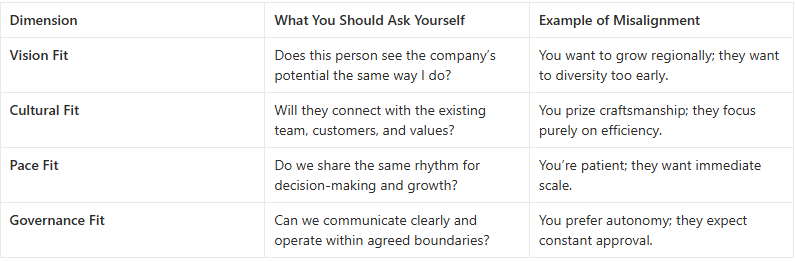
The strongest owner–operator relationships have all four aligned.
The weakest break down because one was never discussed.
This is why, before hiring anyone, it’s worth taking time to write your Operator Blueprint, a one-page reflection on what kind of person can truly carry your vision forward.
What Arnault, Buffett, and the HoldCos Know
If you look at masters of delegation such as Bernard Arnault and Warren Buffett, as well as many of today’s HoldCo founders, you will see that they all share one core trait: they hire exceptional managers and then give them the freedom to lead.
Arnault runs LVMH with over seventy-five CEOs, each managing their own maison. He doesn’t meddle in every campaign or product. But he governs through rhythm, which involves consistent reporting, cultural alignment and strategic reviews.
Buffett does the same. He once said:
“I don’t tell the CEOs of Berkshire companies what to do. I just tell them what not to do.”
Both embody what I call trust with structure, a leadership approach where autonomy thrives inside clear boundaries.
In the small business world, the same logic applies. Whether you’re acquiring a €3 million manufacturing firm or a €5 million service company, your job as owner is to design the conditions for leadership success, not to play the operator yourself.
As one HoldCo founder told me in an interview:
“You can’t scale if everything flows through you.”
Governance is the scaffolding that lets delegation work. Without it, everything collapses back into chaos.
The Leadership Shift
In your first year as a business owner, it’s easy to fall into the habit of being involved in every aspect of the business, from attending every meeting to approving every invoice and replying to every customer. This can feel responsible, even heroic.
But the truth is: If your operator cannot act without you, it means you haven’t delegated; you’ve just duplicated yourself.
The leadership shift happens when you realise your real value is not inside the day-to-day. It’s above it.
It’s in capital allocation, talent selection, and strategic discipline.
To operate like a HoldCo, you must think like one.
And that means transitioning from “doing” to “deciding.”
From “managing” to “mentoring.”
From “control” to “confidence.”
The Action Section → Write Your Operator Blueprint
Let’s make this practical.
Grab a notebook or open a blank page. This is your short leadership exercise.
It’s designed to help you define what kind of operator your business and your personality really need.
Step 1: Define Your Role
👉 Ask yourself:
What kind of owner do I want to be?
Do you see yourself as the strategist, the builder, or the mentor?
Your operator should complement that, not replicate it.
Step 2: Describe the Ideal Operator
👉 List three qualities beyond experience:
e.g. “Calm under uncertainty”, “Empathetic but decisive”, “Resilient communicator.”
Then, describe in one sentence what success would look like after two years of working together.
Step 3: Set the Governance Rhythm
👉 Decide your ideal interaction pattern:
Weekly calls? Monthly board reviews? Quarterly deep dives?
Governance works when expectations are explicit.
Step 4: Draft Your Alignment Framework
👉 Write down:
What decisions will always stay with you?
Which ones are delegated fully?
What are the red lines?
The clearer this is before hiring, the fewer conflicts later.
Step 5: Reflect on Emotional Fit
👉 Finally, ask the hardest question:
Would I trust this person to run the business while I disappear for three months?
If the answer isn’t yes, keep looking.
That’s not about perfection, it’s about peace of mind.
7. Why This Matters More Than Ever
The ETA movement is growing fast. Across Europe and the U.S., thousands of acquirers are buying small businesses every year. But many underestimate the second phase. This is the human phase.
Money closes the deal. People make it work.
When you delegate to the right operator, you don’t just gain time, you multiply outcomes. You unlock scale. You preserve culture. You build something sustainable enough to outlive your own attention.
Every HoldCo that compounds for decades, from Berkshire to Chenmark, have one thing in common:
they treat leadership as a system, not an accident.
📍 Community Highlight
We’re co-hosting the next ETA Amsterdam meetup with Flippa. It’s an evening where business owners, investors, and acquisition entrepreneurs can discuss growth, exits and digital acquisitions. Hear insights from Flippa on global acquisition trends and from me on how digital deals complement traditional buyouts. Then stay for networking, drinks, and real conversations with like-minded operators.

Closing Reflection
The operator you hire will always reflect the owner you are.
If you’re thoughtful, humble, and strategic, you’ll attract people who think that way too.
If you lead by control, you’ll find yourself surrounded by dependency.
And so the real question becomes:
👉 Who do you need to become to lead the kind of operator your business deserves?
That’s the quiet work.
That’s the leadership gap between acquisition and ownership.
And that’s where transformation begins.
When you change how you lead, everything under your ownership changes too.
Hit reply. Share your thoughts. I am happy to read every single one.
Until next Monday,
Alexander