
What Eleven US Acquirers Taught Me About Post-Acquisition Governance
The three cross-theme insights that will shape how I approach my own acquisition, and how they translate to European ETA.

Hello, and welcome back to Buyout Diary.
Most writing on ETA covers what happens before the close. How to find a business. How to fund a deal. How to negotiate an LOI. How to run diligence. What almost nobody writes about is what happens after the close, once the acquirer owns a business and has to actually govern it.
That gap is where I spent my MBA research thesis. When I started the programme I already knew I was moving away from starting businesses and toward acquiring them. What I could not find, in any serious academic literature, was research on what happens after the acquisition closes.
The gap was even larger for HoldCo-style acquirers. How do you delegate operational control to an external CEO while retaining strategic oversight, in a small business context where formal governance mechanisms are often absent by default? That question sat mostly unanswered.
I wanted to research European ETA specifically, Germany cross-border to the Netherlands where I live and search. But when I looked for existing academic literature to build on, there was not enough of it. European ETA research is still in its early years, particularly on post-acquisition governance. So I made a practical choice. Go to the largest ETA market, the United States, where the ecosystem is a decade ahead and the research base is richer, and bring the findings back to Europe.
Eleven interviews, four themes, one dissertation. The findings below are the honest summary. If you want the full paper, including the citations, methodology, and interview quotes, you can download it here: MBA thesis link.
The research in brief
A short note on the study before the findings, so you can trust the summary that follows.
Eleven semi-structured interviews with US-based practitioners, conducted in June 2025. HoldCo founders, self-funded acquirers, investors, franchise-model acquirers, and one independent sponsor. Notably, no traditional search fund entrepreneurs in the sample, though one interviewee described a search fund-style governance model. The composition reflects who was willing to be interviewed on the record about post-acquisition governance in mid-2025. It also mirrors the current US ETA ecosystem, where self-funded remains the dominant model despite the visibility of the search fund template.
Interviews between 45 and 60 minutes each, conducted remotely, transcribed and anonymised. Thematic analysis using Braun and Clarke’s six-phase model.
The research question: which governance structures, control mechanisms, incentive alignment practices, and knowledge transfer processes influence the ability of HoldCo-style acquisition entrepreneurs to delegate operational tasks to external CEOs while retaining strategic control?
Four themes emerged from the coding. Plus three cross-theme insights that turned out to matter more than any single theme. Those insights are the editorial spine of this issue.
Finding 1: Governance is hybrid and adaptive, not templated
Very few of the acquirers I interviewed used traditional corporate boards. Some used advisory-style boards. Others relied on informal peer networks or investor committees. A few operated with essentially no formal governance at all, relying on personal oversight and trust.
The specific patterns:
Informal trust-based governance was common in self-funded acquisitions. One acquirer told me: “There isn’t really much of a formal governance or control structure.” Personal oversight, direct involvement, monthly reviews. Works when the acquirer is close to the operation and the business is small.
Advisory-style boards appeared with acquirers who wanted external input without institutional bureaucracy. Peer investors, industry advisors, occasional strategic reviews. Modelled loosely on Jim Stein Sharpe’s approach to ETA governance.
Hybrid structures combined informal culture with formal reporting. Weekly EOS-style meetings for operational alignment. Quarterly board reviews for strategic direction. Trial periods and replacement rights for the CEO.
Investor-led governance appeared in search fund-style models, where the acquirer accepted structured oversight in exchange for capital. Boards controlled by investors, quarterly updates, defined exit horizons.
LPAC-style advisory committees appeared in independent sponsor structures. Not formal boards but close, providing strategic guidance and investor accountability without full board authority.
The finding across all patterns: governance is adaptive, not standardised. Acquirers blend structures to match the operator, the business, and the capital model. There is no template. There is only the discipline of designing governance appropriate to context.
The principle for a European reader: your governance model will not come from a book. It will come from your capital structure, your operator, and your business. Study the American patterns as options, not prescriptions.
Finding 2: Principal-agent risk is managed through trust and incentives, not just formal control
This finding surprised me. Agency theory, going back to Jensen and Meckling in 1976, assumes that principals and agents need formal contracts, monitoring systems, and structured incentives to align interests. What my interviews showed was more nuanced.
The strongest acquirers managed principal-agent risk through:
Cultural and value alignment. Operator fit was more important than operator credentials. One acquirer said: “Businesses don’t fail, entrepreneurs quit. Make sure you buy a business you’re willing to stick with.” Another applied the same test to hiring an operator.
Milestone-based equity vesting. Phantom equity, delayed vesting, and performance triggers were common. One interviewee reflected on early equity: “We gave him 5% from day one. In hindsight, we should have used vesting based on milestones.” The lesson: unearned equity creates entitlement, earned equity creates alignment.
Employee ownership as a governance tool. One acquirer used broad-based employee equity as a way to align every team member with company performance, not just the CEO.
Trusting instinct in operator selection. Multiple interviewees described relying on their instincts about operators, even when the formal credentials looked strong. As one investor put it: “When there’s doubt about an entrepreneur, you should typically trust your instincts. It’s probably a signal.”
The finding: agency theory works, but trust and incentive design carry more weight in practice than formal monitoring. In small business acquisitions where full-time governance staff are impossible, informal control mechanisms scale better than formal ones.
The principle for a European reader: incentive design is more important than formal reporting. Get the incentives right and you will need less oversight. Get them wrong and no amount of reporting will save you.
Finding 3: Delegation is phased, not immediate
Very few acquirers I interviewed handed over operational control on day one. Most followed a phased pattern.
Phase 1: owner-operator or heavy involvement. The acquirer stays close to the business, learning the operation, building trust with the team, understanding the informal systems that never appeared in due diligence.
Phase 2: gradual transition. As trust develops and systems are documented, the acquirer transitions to a CEO role or hands day-to-day operations to a promoted internal candidate or hired external CEO.
Phase 3: strategic ownership. The acquirer moves fully to owner role, engaged in strategy and capital allocation but not operations. This phase often takes twelve to twenty-four months to reach.
The tools used to enable this transition were remarkably consistent across the interviews:
EOS (Entrepreneurial Operating System) for weekly operational alignment. Not designed for acquisitions, but repeatedly cited as effective.
Dashboards and shared services. Larger HoldCos ran fractional CFO functions from central teams, giving real-time visibility across portfolio companies.
Trial periods and replacement rights. Contracts that let the acquirer replace the operator if performance did not meet expectations. Not a threat, a safety net.
Quarterly strategic reviews. Structured moments to zoom out from operations and check trajectory.
The principle for a European reader: plan for phased delegation, not instant handover. Budget twelve to twenty-four months to reach true strategic ownership. Any faster and you have probably not built the operator relationship deeply enough.
Finding 4: Seller continuity is more than knowledge transfer
This is the finding that shifted most as the research progressed. It began as a knowledge transfer question. By the end of the coding, I understood it as a cultural, relational, and operational question all at once.
What the interviews showed:
Sellers who stayed as employees, minority shareholders, or advisors enabled the tacit knowledge transfer that the numbers, contracts, and financial statements could not capture. Customer relationships, supplier expectations, team dynamics, unwritten processes.
Structured seller involvement, twelve to twenty-four months with a defined role, worked. Unstructured or open-ended involvement created confusion about who was in charge.
When sellers left abruptly, either from health issues or emotional detachment, operational gaps appeared quickly. One interviewee described losing “the full handover” when the previous owner became seriously ill during transition.
Buyer-led system changes early on disrupted operations even when the changes were rational. One acquirer changed the point-of-sale system, the internet provider, and internal systems in the first weeks. “Nothing worked,” they said.
Founder ego and psychological ownership could block knowledge transfer even when the seller intended to help. “Businesses are direct reflections of their owners. It might just be their blind spot.”
The finding: seller continuity is a cultural stabiliser, not just a knowledge channel. The seller who stays becomes the bridge between the old ownership and the new. Customers watch that relationship. So do employees. So do suppliers. When the bridge is stable, transitions work. When it collapses, transitions become expensive.
The principle for a European reader: negotiate seller continuity into the deal terms. Twelve months minimum. Defined role. Structured handover milestones. Do not wait until after close to figure it out.
The three cross-theme insights
One editorial note before the cross-theme insights. Reading the four findings across all eleven interviews, one thing became clear to me: these are not American patterns. They are patterns that work in every country I know. The research context was US-based because the ecosystem is a decade ahead and the academic literature was richer. But the findings themselves are portable. A European searcher does not need to wait for a European version of this research to start applying the principles today.
Four findings gave me four principles. But three cross-cutting insights turned out to matter more than any single finding.
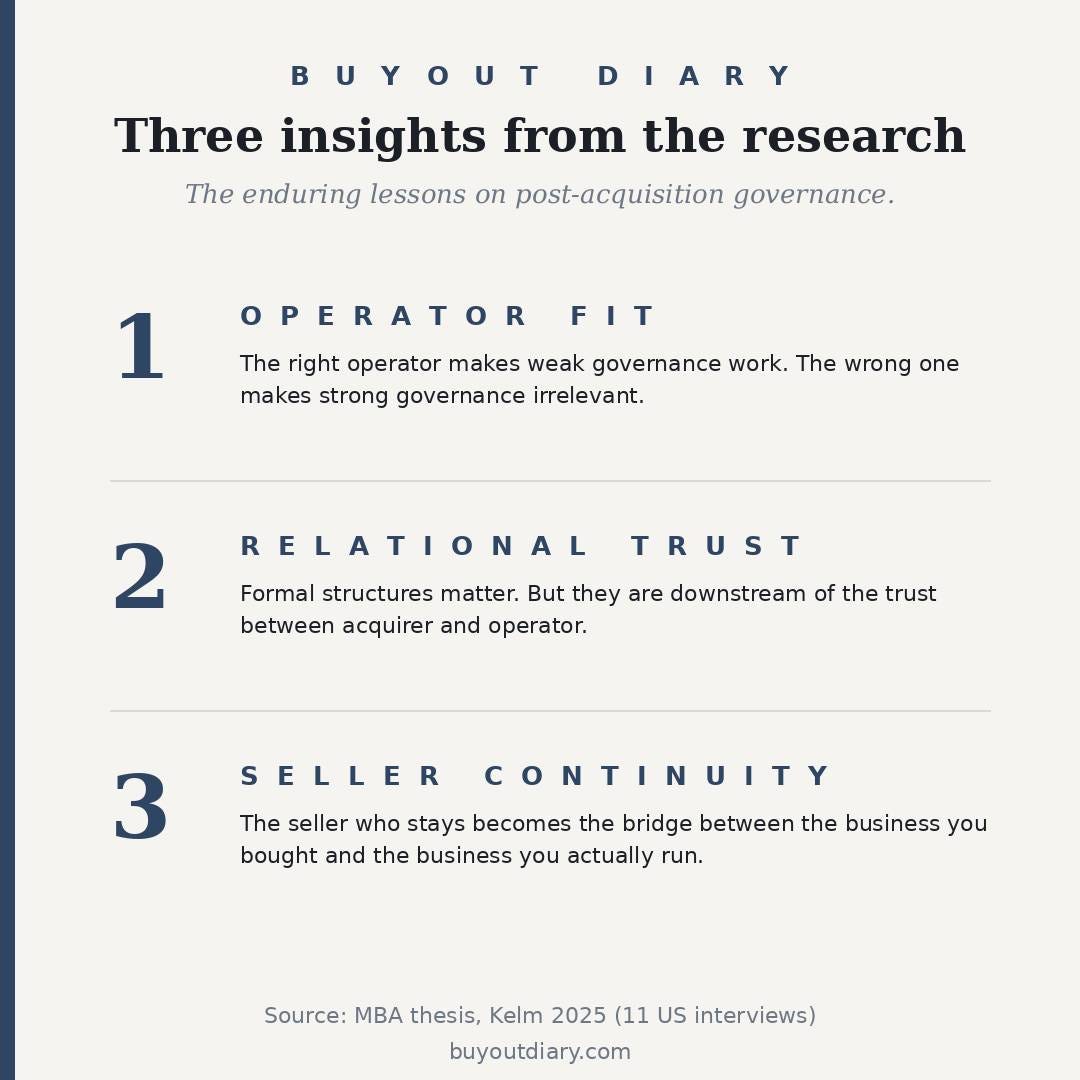
One, operator fit is a critical determinant of governance success. Not technical skill. Cultural alignment, leadership readiness, motivational congruence. The right operator makes weak governance work. The wrong operator makes strong governance irrelevant. If you get operator fit right, most governance problems become tractable. If you get it wrong, no governance framework will save you.
Two, relational trust underpins effective delegation in the absence of formal structures. In every interview where delegation worked, there was underlying relational trust between the acquirer and the operator. In every interview where delegation failed, that trust was either absent from the start or eroded early. Formal structures matter, but they are downstream of the trust relationship.
Three, seller continuity is a cultural stabiliser, not just knowledge transfer. This is the insight I would emphasise most for a first-time acquirer. The seller who stays becomes the bridge between the business you bought and the business you actually run. Preserving that bridge matters more than the specific knowledge being transferred.
These three insights are the enduring lessons. Everything else in this issue can be forgotten if you remember these.
What the research did not cover
Honest about the limits.
Three European-specific areas the American research did not touch, and which any European acquirer will need to answer locally:
Country-specific employment law and works councils in the first months after acquisition. German co-determination, Dutch works council rights, French comité social et économique dynamics. Each of these shapes what a new owner can do, when they can do it, and how much notice they must give. The American research assumes none of this.
The role of family in the team’s reception of the new owner. European SMEs, particularly in Germany, the Netherlands, and Italy, are more often family-run in a substantive sense. Family members work in the business, sit on advisory boards informally, and shape team culture. When the new owner arrives, they arrive into a family system as much as a business system. The American interviews did not address this deeply.
European lender expectations after close. Sparkassen, Volksbanken, BNG, Crédit Mutuel, KfW-backed structures, and regional development banks all watch newly-extended credit lines closely in the first six to twelve months. The relationship management required is different from what a US acquirer with SBA financing experiences. This is a European-specific competence.
The American research gives you the framework. It does not give you the country-specific implementation.
What I will do differently in my own acquisition
One insight I want to name specifically, drawn from multiple interviews in the research. Several acquirers told me some version of the same thing. Do not overcomplicate your operation. Do not over-explain, over-structure, or over-systemise your post-acquisition governance. Keep it simple. Document what needs documenting. Trust the operator. Adjust as you learn. That is the discipline I will bring to my own first acquisition, more than any specific framework.
The other lesson I am carrying forward is on seller continuity. Every future LOI I sign will include structured seller continuity terms from the start. Twelve months minimum. Defined role. Handover milestones. Not a nice-to-have. A term of the deal.
And I will screen operator candidates specifically for cultural fit, not just credentials. The interviews were unambiguous. The right operator makes weak governance work. The wrong operator makes strong governance irrelevant. Credentials tell me what someone has done. Cultural fit tells me whether they will do it here, with me, for this business.
What this means for a European searcher this week
Three actions scaled by ambition.
Smallest step. Pick one of the four findings above and write down how you would apply it to a business you are already interested in acquiring. Not a hypothetical business. A specific one. If you cannot make it concrete, the finding is not yet useful to you. If you are earlier in the journey and do not yet have a specific business in view, use one of the findings to sharpen your search thesis instead. The same discipline applies.
Bigger step. For your current or next diligence, add a specific question to your operator interviews about the three cross-theme insights: cultural fit, trust dynamics, and seller continuity plan. Score each on a scale of one to five. Anything below three is a flag before you sign the LOI, not after.
Boldest step. If you have already closed a deal, do a governance retrospective. Look at each of the four themes. Where is your governance strong? Where is it thin? What did you not build that this research suggests you should have?
Close
The research is done. The findings are here. The application is what happens next.
The gap between American and European ETA governance is not as large as I feared when I started this project. The principles largely translate. The country-specific implementations do not. That is where the next decade of European ETA writing needs to focus.
I am grateful to the eleven acquirers, operators, and investors who gave me their time and their honesty. The dissertation would not exist without them. Neither would this piece.
If one of the four findings above describes a question you are wrestling with right now, reply and tell me which one. The application to European contexts is where I want the next thirty conversations to go.
See you next Monday.
Alexander