
The 2026 INSEAD ETA Conference, from inside the room.
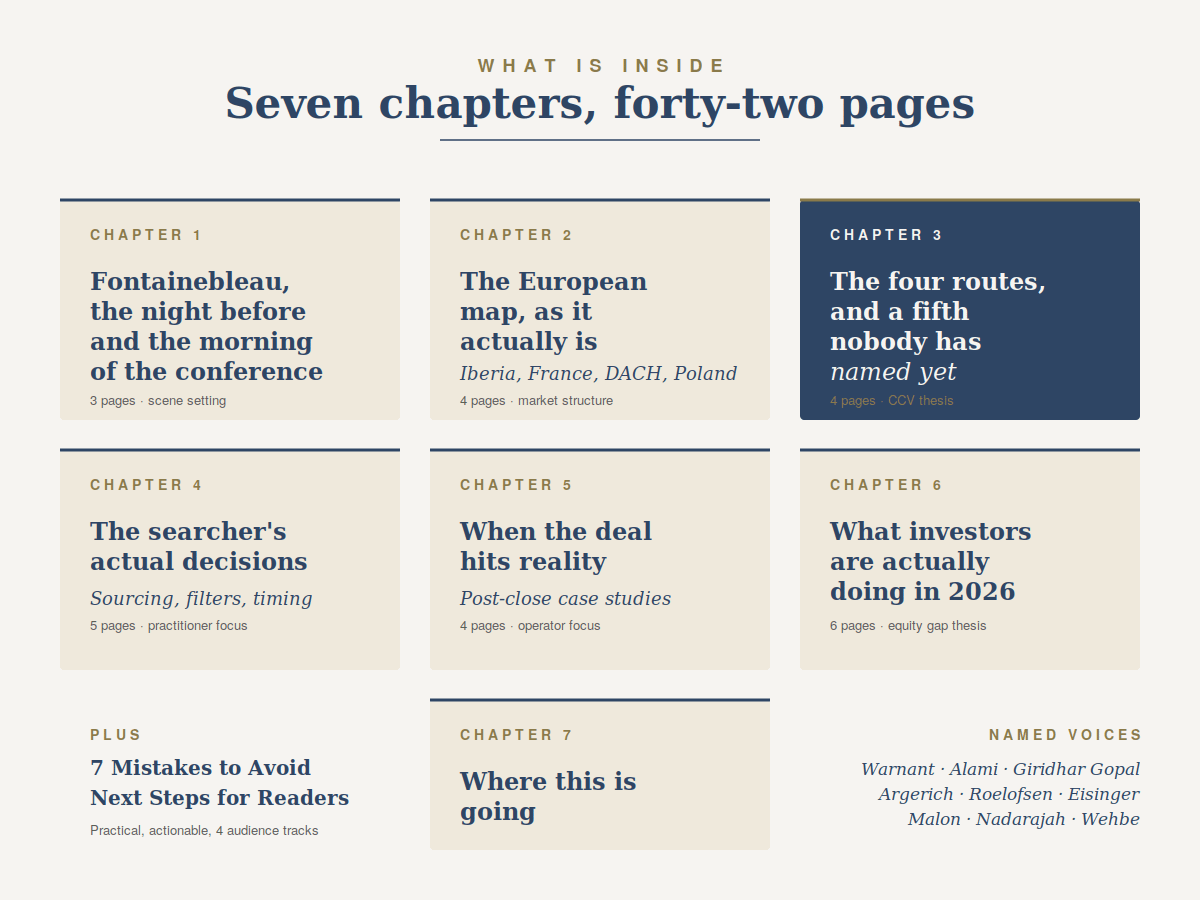
Fontainebleau, 9 May 2026. Six hundred attendees, four named on-record interviews, forty-two pages of independent reporting.

What you get
→ 42-page independent report on the 2026 INSEAD ETA Conference
→ Four named on-record interviews with European searchers and investors
→ Seven mistakes to avoid, next steps for four different audience types
→ PDF delivered instantly, yours to keep
Why this report exists
European ETA conferences run every year. The sessions are strong. The people in the room are the ones actually building acquisition entrepreneurship in Europe. The problem is what happens after.
Slides get shared inside personal networks. Frameworks stay in private Notion pages. The knowledge that came out of Fontainebleau on 9 May 2026 was accessible to the 600+ people who attended, and effectively nobody else.
There is no equivalent of the Stanford Search Fund Study for European ETA. No independent editorial layer covering the conferences that shape the field. What exists is speaker-list summaries and accelerator marketing.
This report closes the gap for one conference. Independent journalism, respectful of embargoed research, built from three pre-conference interviews with Yves Warnant, Ghislaine Alami, and Veena Giridhar Gopal, plus an on-record interview with Jaume Argerich at Fontainebleau on the day.
Every interview and quote in the report was reviewed and approved by the named voice before publication. Three pre-conference interviews (Warnant, Alami, Giridhar Gopal), one on-record interview at Fontainebleau (Argerich), plus additional named voices from the room and follow-up conversations (Roelofsen, Eisinger, Malon, Nadarajah, Wehbe).
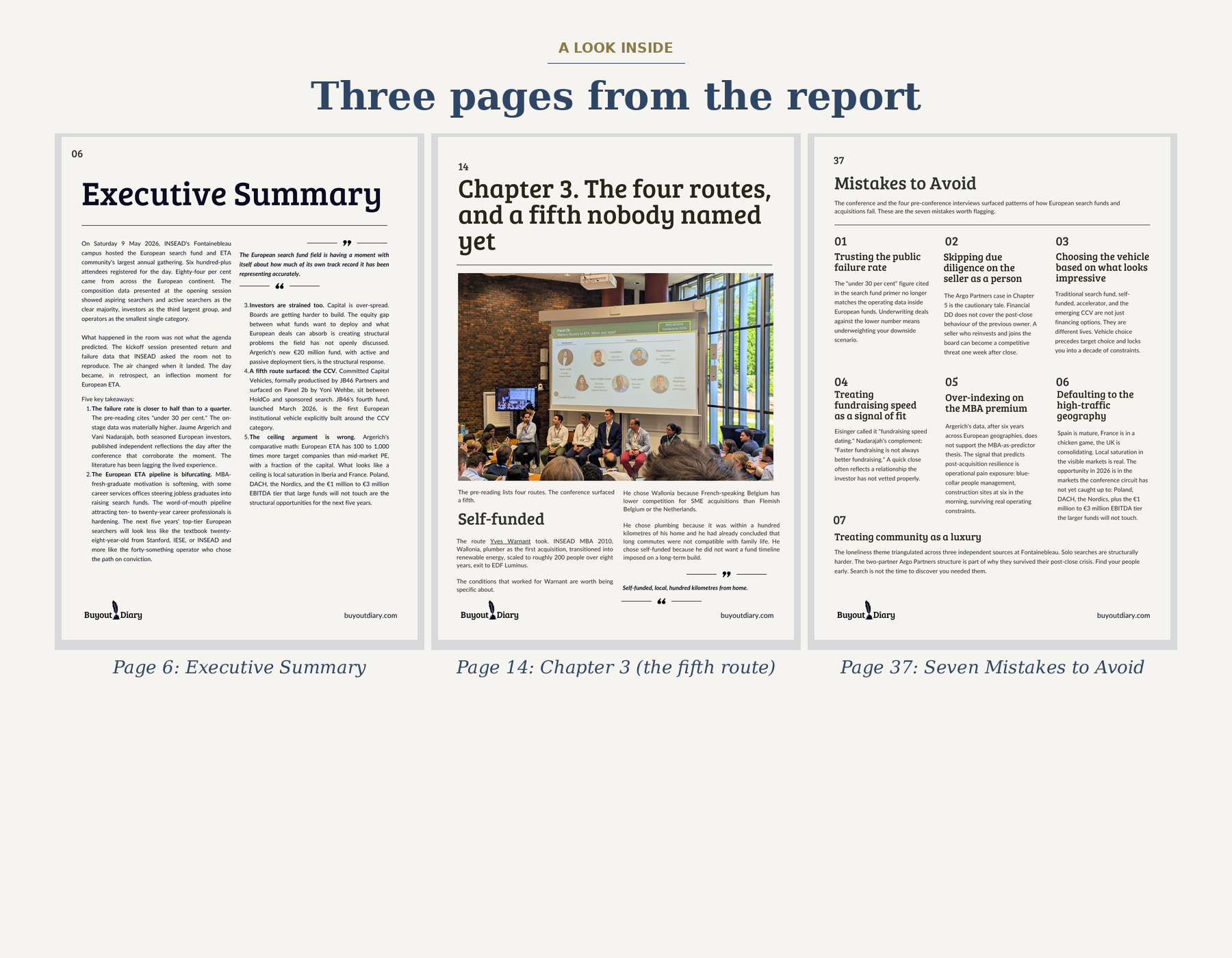
An excerpt:
“By 21:00 I was walking into central Fontainebleau. The bar I had hoped to find open was already closed. The walk to the Airbnb passed a group of investors sitting outside one of the restaurants on the rue, mid-conversation, one bottle of red between them and time to extend the evening.
The actual dinner was elsewhere, and it was the editorial unit of the evening. I had met an Indian searcher walking through town. We ended up at a restaurant in front of the Château de Fontainebleau. Over dinner, two observations surfaced and connected.
The first was a comment about the alumni dynamic of the conference. Maybe ninety per cent of the people coming to ETA conferences are not really doing this. They are doing the alumni weekend.
He said it without bitterness. It was an observation about how the field looks from inside, not a complaint.”
The rest of the report reads like this. Specific scenes, named voices, structural arguments backed by data the room heard on the day. Chapter 3 introduces the CCV, a fifth financing route the pre-reading did not name. Chapter 6 lays out the equity gap between what European search fund investors want to deploy and what deals can absorb. Chapter 7 argues that European ETA is at the beginning of a generational reformation, not at a ceiling.
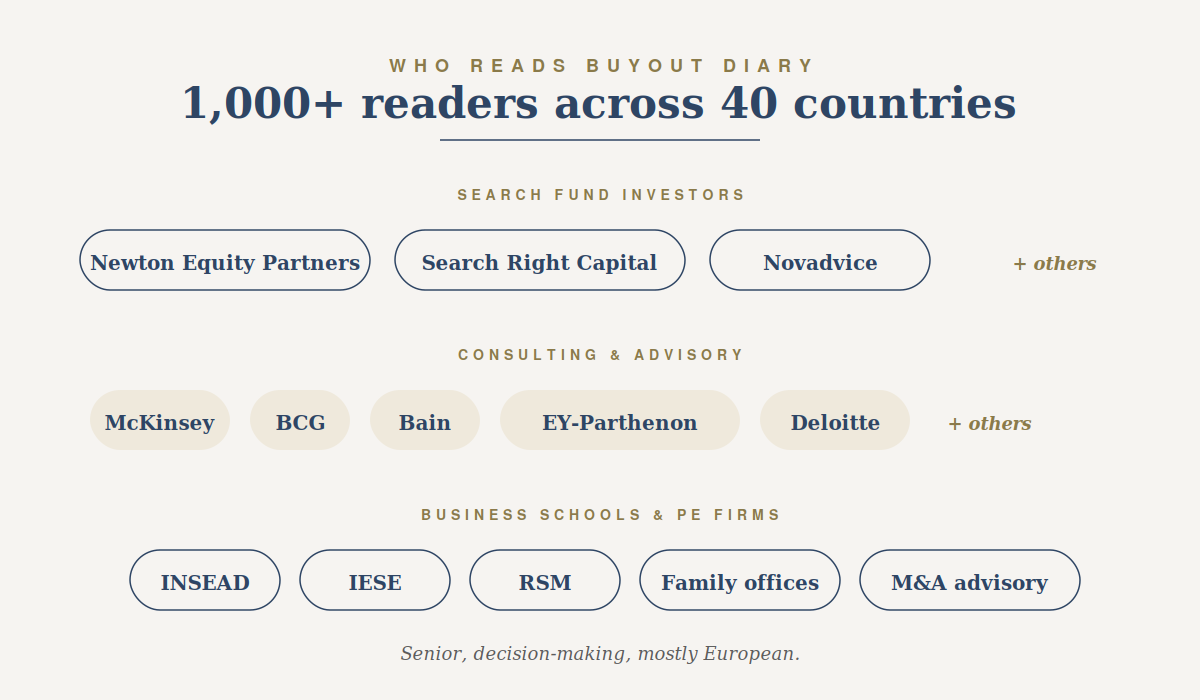
If you were at INSEAD this year, this report is the record that persists after the conference ends. If you were not there, it is the closest substitute to being in the room. Not for readers looking for beginner ETA content — this assumes you know the basics.
About Alexander
Alexander is an Amsterdam-based acquisition entrepreneur actively searching for a business to buy across the Netherlands, Flanders, and northwest Germany. Founder of Buyout Diary, the weekly newsletter documenting European ETA, and of ETA Europe, the in-person community with meetups in Amsterdam, Brussels, and Paris.
Background: MBA on HoldCo-led small business acquisitions (University of Greenwich and Saxion University of Applied Sciences, August 2025). Before that, PwC, Rabobank, Commerzbank, Deutsche Postbank. Guest lecturer at Saxion UAS on ETA and SME succession.
The INSEAD report is the first of four conference reports Buyout Diary is publishing in 2026, alongside the free weekly newsletter and a YouTube channel launching later in 2026. This work is the editorial infrastructure that European ETA has been missing.
Questions
Is this independent, or commissioned?
Fully independent. Not commissioned by INSEAD, not sponsored by any firm named in the report. Published by Buyout Diary, my media business. Embargoed research from the conference is respected and not reproduced.
Are the quotes and interviews real?
Every named interview was conducted on record and approved by the named person before publication. The pre-conference interviews (Yves Warnant, Ghislaine Alami, Veena Giridhar Gopal) happened over video call in the weeks before the conference. The Argerich interview took place at Fontainebleau on the day. Everyone quoted saw their words before the report went to print.
How is this different from a free conference summary blog post?
Free summaries recap the panel schedule. This report reconstructs the field. Three pre-conference interviews to establish the pre-existing terrain. Direct observation of what shifted on the day. Post-conference verification against the record. The output is 42 pages of analytical structure, not a bullet-point recap.
Is 42 pages actually deep enough?
Yes. The report is dense — Executive Summary, seven chapters, seven mistakes to avoid, next steps for four different audience types, plus acknowledgements and methods. Reading it takes roughly an hour. It is not padded, and it does not repeat itself.
Is this worth €39?
Attending INSEAD costs upwards of €300 before travel and accommodation. Reading the report takes an hour and gives you the substance. €39 is what a decent lunch costs. If European ETA in 2026 matters to your work, that comparison is easy.
When was the report published?
Published on 16 May 2026, one week after the conference. That gap was intentional — enough time to verify quotes with named voices, short enough that the substance is still current.
What about IESE, RSM, and other European ETA conferences?
Buyout Diary is publishing four reports in 2026. INSEAD is out now. IESE (Barcelona) publishes in October, RSM (Rotterdam) in November, and a Year-End Synthesis of European ETA in December. If you want all four in one purchase, see the Conference Pass at the bottom of this page.
How do I receive the report?
As a PDF, delivered to your inbox within minutes of purchase. Automated through Kit. No account required.
Can I share it with my team?
Yes, within reason. If your firm wants to distribute it more broadly (multiple offices, training material, distribution to portfolio companies), reply and we sort out a team licence.
What if I disagree with the analysis?
Reply to any email from me. The report is not neutral — it takes positions, especially on the CCV thesis and the equity gap analysis. Disagreement is welcome. Serious pushback is what makes the next report better.
I am not a searcher. Is this still relevant?
Yes, if you work adjacent to European ETA. Investors read it to understand the deal pipeline. Advisors read it to understand what founders are actually deciding. Consultants and academics read it to keep pace with a market that moves faster than the literature. If you sit somewhere in this ecosystem, the report is calibrated for you.
Ready?
INSEAD is the first of four. The Conference Pass bundles INSEAD with IESE (Barcelona, October), RSM (Rotterdam, November), and the Year-End Synthesis (December). €129 for all four, or €39 for the INSEAD report on its own.
This is the founding cohort period. Feedback from early readers directly shapes the IESE report in October.
Written in Amsterdam. Inspired by the journey.
© 2026 Buyout Diary · Built with ❤️ in Amsterdam