

Here is the question every reader of this piece is asking: is self-funded search the right model for me?
Last week’s piece opened with a reversal. In the academic ETA world, the traditional search fund is the number one model. In the actual ETA world, it is one option among many. This week’s piece opens with the same reversal in the other direction.
In the European ETA conversations I have, self-funded search comes up far more often than the academic literature would suggest.
Ener and Dávila’s peer-reviewed 2023 paper in the European Management Journal, What makes search fund entrepreneurship different in Europe?, makes the case with specific data from four European countries. Their conclusion from Dávila: “Don’t take the American playbook, come here and try to execute on it, because you are going to fail.” Argerich’s day-after LinkedIn reflection from the INSEAD ETA Conference 2026 confirmed the same pattern: “alternatives to traditional search funds are growing, particularly self-funded deals.” Freiling and Oestreich’s 2022 study of search funds in Central Europe explains the structural reasons.
Self-funded is not uniquely European. It is the global pattern for smaller deals. But the European ecosystem, especially the DACH-Benelux corridor, has built purpose-built infrastructure around the model in a way that the Anglo-Saxon literature has under-documented. That gap is the whole editorial point of this piece.
One more thing this piece does that most Anglo-Saxon ETA writing does not: it names MBI (Management Buy-In) as the European practitioner term for the same underlying model, and takes European skilled-trades succession infrastructure seriously as the ecosystem that supports it.
This issue answers the seven questions the intro promised: what the model is, what it costs, who it fits, who it does not, where it works in Europe, how it fails when it fails, and the honest downside. By the end, you should know whether self-funded search fits you, and where the European MBI variant fits in.
What the model is
Self-funded search is defined more by what it is not than by what it is.
It is not a traditional search fund. There is no institutional search capital vehicle. There is no standardised syndicate of ten to twenty investors buying units at defined prices. There is no fixed shareholder agreement with predetermined vesting, hurdle rates, and Bad Leaver clauses.
What it is instead: a flexible structure where the searcher retains structural control and negotiates capital as needed. That flexibility is the whole point.
Some self-funded searchers work entirely alone, funding their search from personal savings and part-time consulting income, then closing an acquisition with personal equity plus bank debt plus seller notes. Others bring in family capital during the search phase, then structure the acquisition equity as personal capital plus one or two small mentor tickets from network investors who provide capital without demanding institutional governance. Still others operate somewhere in between, adjusting the capital arrangement to fit the specific deal.
The defining features are structural, not numeric. The searcher funds the search independently and negotiates the ownership structure when a deal takes shape. There is no institutional syndicate imposing standardised terms. Governance is negotiated deal-by-deal, not defined by a template shareholder agreement. Hold periods are often indefinite because there is no fund clock.
This flexibility is why self-funded looks different across searchers. What matters is not the specific capital arrangement but that the searcher owns the structural decisions.
The comparison to the reference model matters. Where the traditional search fund exchanges equity for infrastructure, self-funded reverses the trade. You give up the system to gain the ownership.
The European vocabulary: MBI, MBO, and skilled-trades succession
MBI (Management Buy-In) is a term European succession advisers use when an external manager acquires a business. Many self-funded acquisitions are MBIs, but the terms are not interchangeable: MBI describes who takes over; self-funded describes how the search is financed. Different vocabulary because MBI grew from European succession advisory practice while self-funded search grew from Stanford ETA literature.
MBI in European practitioner language covers a spectrum. This piece covers the self-funded end, where the external manager brings personal or negotiated capital. At the investor-backed end, the manager may partner with a sponsor. The financing and governance then depend on that arrangement. That model will be covered in a later issue.
MBO (Management Buy-Out) is the internal variant. An existing manager or long-tenured employee acquires the business from the owner. The starting point is different: the buyer already works in the business. Financing can vary in both MBIs and MBOs. Common in family business succession where no family successor exists but a trusted manager is willing to take on the ownership.
The skilled-trades succession wave is European, not German. Across the DACH-Benelux corridor, France, and much of Southern Europe, ageing owners of blue-collar and craft businesses face succession without ready internal successors. Small self-funded deals fit this segment because the businesses are too small for traditional search fund infrastructure and too specific for institutional PE. Germany’s system is the most developed and best documented, but the same pattern exists across Europe.
Germany as the reference case: according to KfW’s Nachfolge-Monitoring Mittelstand 2025, approximately 109,000 German SMEs seek succession annually until 2029, with average purchase price expectations of €499,000. The Zentralverband des Deutschen Handwerks (ZDH) reports 125,000 skilled-trades businesses seeking succession in the next five years, with one in four owners already 60 or older. Similar succession waves are documented in France (BPI France succession data), Austria (Wirtschaftskammer statistics), and the Netherlands (KVK succession research), though with less centralised reporting than Germany.
Purpose-built infrastructure supports skilled-trades succession across Europe, though each system has eligibility requirements worth naming honestly.
Germany. KfW’s Meistergründungsprämie provides bonus grants specifically for Meister candidates who have completed formal Ausbildung and Meisterprüfung in the relevant trade. That is a real regulatory filter: only qualified Meister can access it. Bürgschaftsbank guarantees enable MBI candidates to secure bank financing they would otherwise struggle to obtain, and these are more broadly accessible. Each of the 53 regional Chambers of Skilled Crafts (Handwerkskammer) runs matchmaking services for Meister-to-Meister transfers and external MBIs. The federal nexxt-change platform lists thousands of businesses seeking successors, most below €500,000 in purchase price.
Austria. Wirtschaftskammer (WKO) runs the equivalent succession advisory service. Austria Wirtschaftsservice (aws) provides Nachfolgekredite (succession loans) with state guarantees. The Meister system operates similarly to Germany, with the same trade-qualification requirements for certain sectors.
France. Chambre de Métiers et de l’Artisanat runs regional succession advisory for skilled trades. BPI France (Banque Publique d’Investissement) provides guarantees for business acquisitions through the Prêt Croissance TPE and related instruments. SIAGI specifically guarantees loans for craft-sector acquisitions.
Netherlands. BMKB (Borgstelling MKB-kredieten) guarantees loans for smaller acquisitions. Qredits offers business loans for acquisitions, with products and limits depending on the borrower.. KVK (Kamer van Koophandel) runs succession consultation services.
Belgium. PMV (ParticipatieMaatschappij Vlaanderen) supports Flemish succession transactions. Sowalfin covers Wallonia with similar instruments.
UK. British Business Bank runs the Growth Guarantee Scheme, which succeeded the earlier Recovery Loan Scheme. Coverage is less specific to skilled trades than in the DACH region, reflecting the UK’s different succession advisory tradition.
The Meister requirement is the strictest eligibility filter across these systems. External searchers without formal trade credentials often work through a partnership structure with a qualified Meister who serves as the Betriebsleiter (technical operations lead), or focus on non-Meister-required categories. This is not unique to Germany; France’s craft sector has similar qualification requirements for certain trades.
Pöschl and Freiling’s 2020 peer-reviewed paper in the Journal of Organizational Change Management, The way toward a new entrepreneurial balance in business succession processes, studied three DACH family firms undergoing MBI succession. Their central concept is the “hard break”: when family businesses undergo family-external succession, there is a discontinuity in how the company conducts entrepreneurial action. Successors lead differently, and building operational rhythm takes time. We come back to this in the failure section.
The economics
Search runway comes from personal savings, spouse income, and often part-time consulting. There is no 50% step-up because no search capital converts. Without outside equity investors, there may be no investor waterfall or performance hurdle. Once investors join a deal, those terms depend on what the parties agree. A searcher who retains control avoids the standard traditional search fund governance structure, but outside capital can introduce board rights and leaver provisions.
The absence of these structures is one part of the freedom the model gives.
Personal financial exposure is the counterweight. Every euro invested in the search comes from the searcher or their family. If the deal fails, the searcher has no portfolio to diversify against, unlike traditional search fund investors who hold ten to twenty positions.
Access to alternative financing varies across Europe. Every country in the DACH-Benelux corridor and beyond has purpose-built instruments for small-deal succession, though the specific programmes differ.
Germany: KfW-Unternehmerkredit and comparable founder loans for succession transactions; Bürgschaftsbank guarantees covering up to 80% of credit risk; Hausbank relationship debt filling the remaining structure.
Netherlands: BMKB guarantees for smaller acquisitions; Qredits business loans, subject to product limits and eligibility; regional development companies (ROMs) supporting sector-specific acquisitions.
France: BPI France (Banque Publique d’Investissement) guarantees through Prêt Croissance TPE; SIAGI guarantees specifically for craft-sector acquisitions; Prêt d’honneur through Initiative France for early-stage capital.
Austria: aws (Austria Wirtschaftsservice) provides Nachfolgekredite and state guarantees for succession transactions.
Belgium: PMV (Flanders), Sowalfin (Wallonia), and Finance.brussels support regional succession transactions with guarantees and co-investment.
UK: British Business Bank’s Growth Guarantee Scheme covers a portion of acquisition debt for qualifying transactions.
The specific instruments vary. The pattern does not. A self-funded searcher in the €1 million to €3 million deal range across most of Europe may be able to subject to the business, lender requirements and each programme’s eligibility rules.
For skilled-trades specifically, credentialing rules add a layer of complexity. Germany’s Meistergründungsprämie is available only to qualified Meister candidates who have completed formal Ausbildung and Meisterprüfung in the specific trade. France has similar qualification requirements for certain craft sectors. Searchers without formal trade credentials access these deals through partnership structures with a qualified craftsperson who serves as the technical operations lead, or through non-credentialed trade categories. That is a real structural constraint on external MBI in the skilled-trades sector across Europe.
Who does the model fit
Three questions determine whether self-funded search fits you. Not credentials. Not ambition. Whether you can answer yes to at least two of these three.
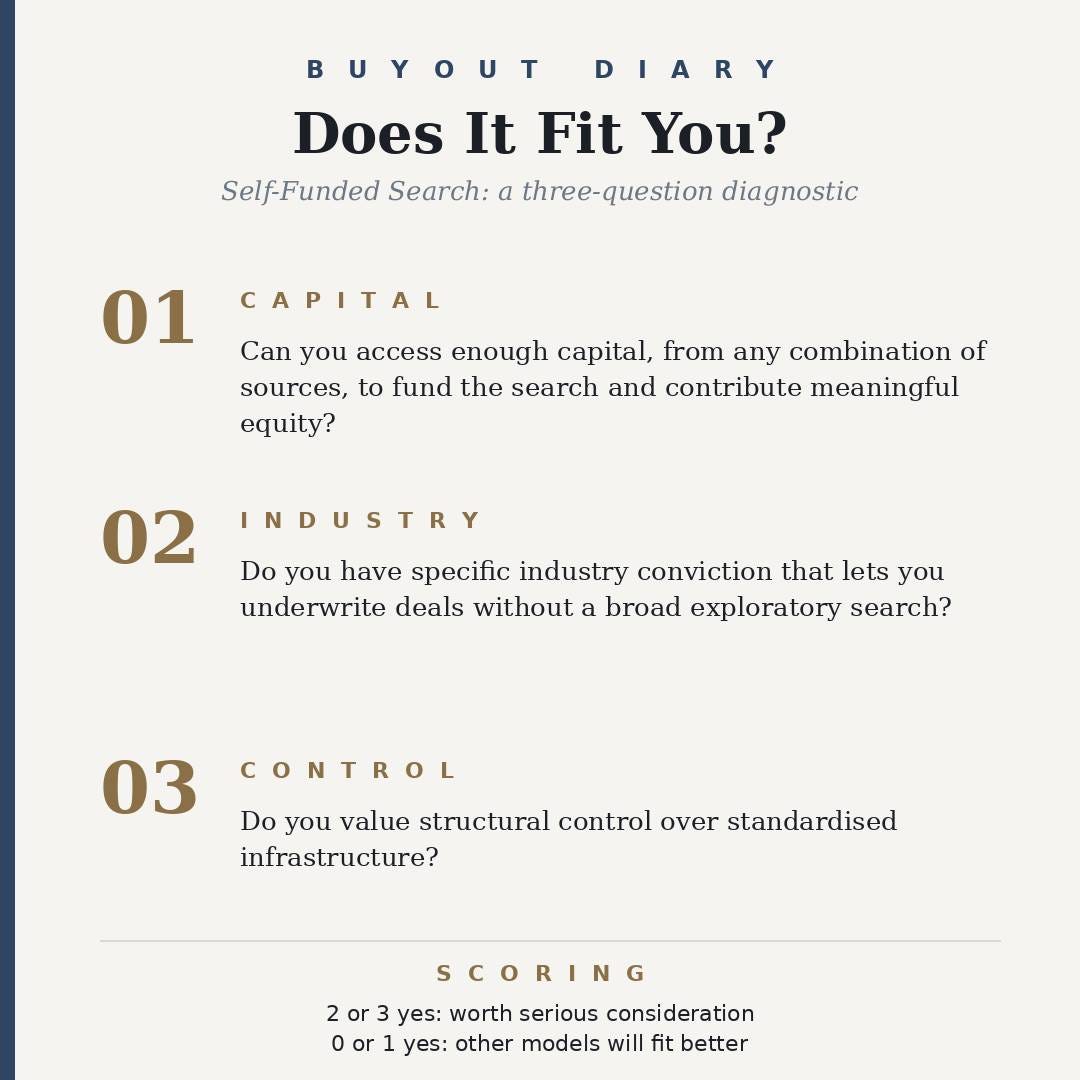
Self-funded is a blank sheet. Traditional search fund is a template. Which one you choose says more about your temperament than your capital.
Question 1: Can you access enough capital, from any combination of sources, to fund the search and contribute meaningful equity at acquisition?
Search runway typically requires 12 to 24 months of personal expenses plus travel and legal costs, roughly €50,000 to €150,000 depending on family situation and geography. Acquisition equity typically requires 20% to 30% of the purchase price. For a €1 million to €3 million deal, that means €200,000 to €900,000 in equity contribution.
Sources are flexible. Personal savings. Family capital. Spouse income supporting the household during the search. Mentor investors who buy small tickets. Deal-by-deal capital partners for specific acquisitions. What matters is that you can piece the capital together on terms you set, not on terms imposed by an institutional syndicate.
Question 2: Do you have specific industry conviction or expertise that lets you underwrite deals without a broad exploratory search phase?
Without funded search capital, an 18-to-24-month exploratory search can be difficult to sustain. A narrower sector or geography can make the search more manageable. Prior industry experience, deep network access in a target sector, or a family business background all count. Recent MBA graduates without industry conviction usually struggle with self-funded search for this reason.
Question 3: Do you value structural control over standardised infrastructure?
The philosophical test. Self-funded searchers set their own governance, negotiate capital arrangements deal-by-deal, and hold indefinitely if they choose. Traditional search fund searchers accept standardised terms in exchange for institutional support. Both are legitimate. But the temperament to build your own structure rather than fit into an existing one is not universally distributed.
The self-diagnostic. Two of three yes: self-funded search is worth serious consideration for you. One or zero yes: other models in this series will fit better. If you scored one, note which question you failed. That answer often points to the model that suits you.
Who does not fit
Those without any credible access to capital, whether personal, family, spouse income, mentor network, or accessible instruments.
Those needing standardised institutional infrastructure at every stage of the search and post-acquisition operation.
Those doing broad exploratory searches with no specific industry conviction.
Those preferring a template shareholder agreement and predetermined governance to negotiating each arrangement.
Those with no debt tolerance. Self-funded acquisitions are typically 50% to 70% debt-financed regardless of the equity structure.
Where it works in Europe
The DACH-Benelux corridor is the natural geography for self-funded search and its MBI variant, but the pattern extends across the continent. Freiling and Oestreich’s 2022 study identifies the structural reasons for DACH markets: well-established alternative financing, cultural preference for direct owner-to-owner transactions, lower control preference among searchers, and weaker MBA culture compared to Iberia or the UK.
The specific infrastructure varies by country but the underlying pattern is European. Germany’s ecosystem is the most centralised, with nexxt-change as the DIHK’s national succession database, Chambers of Skilled Crafts (Handwerkskammer) running regional matchmaking, and Chambers of Industry and Commerce (IHK) offering consultation for MBI candidates. Austria mirrors this structure through Wirtschaftskammer (WKO) advisory and aws state-guaranteed loans. The Netherlands operates through KVK for consultation and BMKB or Qredits for financing. Belgium splits regionally between PMV in Flanders and Sowalfin in Wallonia. France operates through Chambre de Métiers et de l’Artisanat for skilled-trades succession and through BPI France for financing. The UK operates through the British Business Bank’s Growth Guarantee Scheme, with less specific skilled-trades infrastructure than the DACH region.
Contrast with traditional search fund geographies from the previous issue: Spain 59 acquisitions, UK 17, France, Germany, Italy 15 each. Spain is the traditional search fund market. Most of the rest of Europe supports self-funded and MBI more naturally, though both models exist in both regions. The practitioner majority breaks the way the ecosystem supports.
Where blue-collar and skilled-trades succession sit specifically: the whole DACH region, Belgium, and France have deep traditions of formal trade qualifications and craft-sector infrastructure. That makes external MBI harder for uncredentialed searchers but easier for qualified craftspeople or partnership structures with a qualified operations lead. The UK, Nordics, and Southern Europe have different trade-qualification traditions, which changes the shape of self-funded MBI in those markets but does not eliminate it.
How the model fails when it fails
Six failure patterns emerge from the structural features of the model:
Running out of search runway. Personal capital is finite. If the search takes longer than budgeted, the searcher runs out of money and has to abandon.
Loneliness leading to poor decisions. Searchers working alone have no built-in team to challenge their assumptions. Some bring in experienced advisers, mentor investors or other searchers for regular deal reviews. Without that outside perspective, it becomes easier to rationalise a weak deal when time and money are running short.
Overpaying because no external guardrails. Traditional search fund investors screen every LOI. Self-funded searchers who work without institutional guardrails have to be their own. Some fail this test. The mitigation available to self-funded searchers is to bring in trusted advisors or mentor investors specifically for deal review, but this requires the searcher to choose that discipline.
Wrong industry because no external forcing function. Without institutional pressure to justify or defend the industry choice, some searchers drift into sectors they cannot competitively serve.
Personal financial catastrophe if the deal fails. No portfolio diversification. Family capital and personal capital are both at risk.
The “hard break” post-acquisition. Pöschl and Freiling’s peer-reviewed concept: when an external MBI candidate takes over a family business, there is a structural discontinuity in how the company operates. Successors lead differently. Building operational rhythm takes time. Some acquired businesses do not survive this transition.
Real European examples
In an online conversation before the conference, Yves Warnant told me that he chose Wallonia because French-speaking Belgium has lower competition for SME acquisitions than Flanders or the Netherlands. Chose plumbing because within 100 kilometres of home (family life constraint). Scaled the plumbing business over eight years, transitioned into renewable energy, grew to approximately 200 people, exited to EDF Luminus.
“You need to be at ease with plumber jokes and managing plumbers.” The point is not the joke. It is the culture gap. Skilled-trades industries across Europe operate in a hands-on culture that MBA-trained searchers often struggle with. Speaking the culture matters more than the credentials. Warnant chose the region because of language, chose the industry because of geography, chose the model because he did not want a fund timeline imposed on a long-term build.
Worth naming explicitly: Warnant’s acquisition is structurally an MBI. An external MBA-trained manager acquires a skilled-trades business (plumbing) via personal capital plus debt. The European vocabulary describes exactly what happened, even though he came from the Anglo-Saxon ETA training tradition.
Pöschl and Freiling’s peer-reviewed multi-case study of three DACH family firms undergoing MBI succession gives the academic framework for what Warnant lived through. Their “hard break” concept describes exactly the discontinuity Warnant navigated: entering a business built by a family owner, leading differently, and rebuilding operational rhythm through the plumbing years before pivoting to renewable energy.
The challenge of searching alone. A self-funded searcher can choose whom to involve and when. That freedom is valuable, but it also means building your own support around the search. Experienced operators and investors can question a deal before you commit to it, even if they are not part of a formal search fund syndicate.
Warnant’s case shows how the structure can leave room for choices about geography, industry and family life. The autonomy is real, but so is the responsibility to build the support you need around it.
The honest downside
Personal risk concentration. The searcher’s own capital is at risk. Family capital is often at risk. No portfolio diversification protects the searcher.
Structural loneliness. Working independently can become isolating, especially when a search takes longer than planned. You have to create your own sounding board and make use of it before pressure starts shaping your decisions.
No natural forcing function to exit. Self-funded searchers can hold indefinitely, which is a feature or a bug depending on the situation. Some hold too long because there is no fund clock.
High debt can make an acquisition more vulnerable to a downturn, whatever search model was used.
The skilled-trades MBI variant carries an additional risk: the culture gap Warnant named. External managers who cannot speak the language of the workshop, the site, or the manufacturing floor rarely last, regardless of country. Some searchers overestimate their ability to bridge the gap. That misjudgement is often only visible after the acquisition closes.
What you can do this week
Three actions scaled by ambition.
Smallest step. Score yourself against the three questions in the diagnostic card. Two or three yes: self-funded is worth serious consideration. One or zero yes: other models will fit better.
Bigger step. Audit your actual capital access honestly. Personal savings, family capital, spouse income, mentor network for small investor tickets, and country-specific instruments in your target geography. Germany: KfW-Unternehmerkredit and Bürgschaftsbank guarantees. Netherlands: BMKB and Qredits. France: BPI France and SIAGI. Austria: aws succession loans. Belgium: PMV in Flanders, Sowalfin in Wallonia. UK: British Business Bank’s Growth Guarantee Scheme. If you are considering skilled-trades acquisitions, note whether you hold the trade qualification required in your target country or plan to partner with a qualified craftsperson for the operations lead role. Reply with your assessment. Honest answers become editorial fuel for the how-to-choose piece at the end of the series.
Boldest step. Talk to one European self-funded or MBI searcher who has done it. Warnant is on the record and on LinkedIn. Skilled-trades MBI cases surface through Chambers of Skilled Crafts and industry-specific advisor networks in each country. Non-trades MBI cases surface through Chamber of Industry and Commerce networks and general succession advisors. One conversation is worth ten reads of any article.
Sources and further reading
Peer-reviewed academic sources cited in this piece:
Ener, H. & Dávila, A. (2023).What makes search fund entrepreneurship different in Europe?European Management Journal, 41(4), 488-498.
Pöschl, A. & Freiling, J. (2020).The way toward a new entrepreneurial balance in business succession processes: The case of management buy-ins.Journal of Organizational Change Management, 33(1).
Freiling, J. & Oestreich, J. (2022).Is business succession by the search fund model an option for Central Europe?Entrepreneurial Business and Economics Review.
Primary German data:
KfW Research (2026).Nachfolge-Monitoring Mittelstand 2025. Fokus Volkswirtschaft Nr. 526, January 2026.
Zentralverband des Deutschen Handwerks (ZDH).Betriebsnachfolge im Handwerk.
Nachfolgemonitor (ifh Göttingen and Bürgschaftsbanken). Handwerk succession outcomes.
Conversations and practitioner sources:
Yves Warnant (Wallonia self-funded MBI, plumbing to renewable energy, exit to EDF Luminus).
Jaume Argerich (Aniol Family Office six years, now €20 million fund). Day-after LinkedIn reflection, 10 May 2026.
Close
Self-funded search, MBI, and MBO together are the practitioner majority in Europe. Traditional search fund is the reference model. Every model in this series compares against it. Self-funded is what most European searchers actually do with the model choice once they understand the landscape.
The next piece in the series shifts from model to strategy. It covers single acquisition, the default strategy that most self-funded searchers pursue once they own a business. Where this piece was about how you buy, next Monday’s piece is about what you do with what you own.
See you next Monday.
Alexander
Another great piece, Alexander. I think the points you make around the "softer" aspects - cultural fit, impact of solo searching etc are often overlooked/underestimated. We tend to gravitate to the economics but its often these qualitative factors that can have a significantly negative impact on our ability to achieve a successful outcome. Looking forward to your next edition.