

During a panel I ran at ETA Europe in Brussels last month, someone from the audience raised their hand. The panel had already covered five different acquisition models. The person asked, “What is the best model? Buy-and-build model? Or is that a strategy?”
The question came late in the session, after the group had trusted the conversation enough to admit uncertainty. It was not the first thing they said. It was the thing they had been holding.
I hear versions of that question every week now. This morning I spoke to two searchers, one from India and one from the UK, both based in Germany, both still exploring how to fund their first acquisition. They were switching between self-funded and search fund-backed structures, unsure which one fit them best. Both have MBAs. Both come from M&A backgrounds. Neither felt certain.
Newsletter readers have been asking the same question in reply threads and DMs for a year. Which model should I use? What is the difference? Which one fits me?
It is time to answer it properly, in one place, in a way that respects how much the question actually matters.
Why the question is hard to answer in one email
There is no best model in ETA. There is only the best model for you.
I cannot tell a searcher which model is best. Nobody can, honestly. What I can tell them is which models exist, and in which situations each one tends to fit.
The answer depends on the searcher. Capital position, timeline, control preferences, operating experience, family situation, ambition. It depends on the strategy they want to run once they own the business. It depends on the country they search in, the sector they target, and the investor community they can access.
There is another reason the question is hard. Most searchers ask “which model” as if it settled everything. It does not. Model and strategy are two different axes. That is what the Brussels panel question surfaced without meaning to.
Model and strategy are two axes, not one
The model is the structure for capital, time, and control. Who backs you. How long you have. How much autonomy you keep. What happens at exit.
The strategy is how you deploy capital once you have chosen the model. One acquisition or many. Related or unrelated. Consolidating a fragmented market or building a platform.
A searcher with a Long Duration Enterprise structure can run buy-and-build, or pure serial acquisition, or a platform play. Same model, three different searches in practice. Same strategy can be pursued through different models: buy-and-build works inside an independent sponsor structure as much as inside a HoldCo, though the economics and timelines differ.
Buy-and-build is not a model. It is a strategy. Confusing the two is the single most common mistake in ETA conversations. The distinction matters because once a searcher stops trying to force one decision to answer two questions, both decisions become clearer.
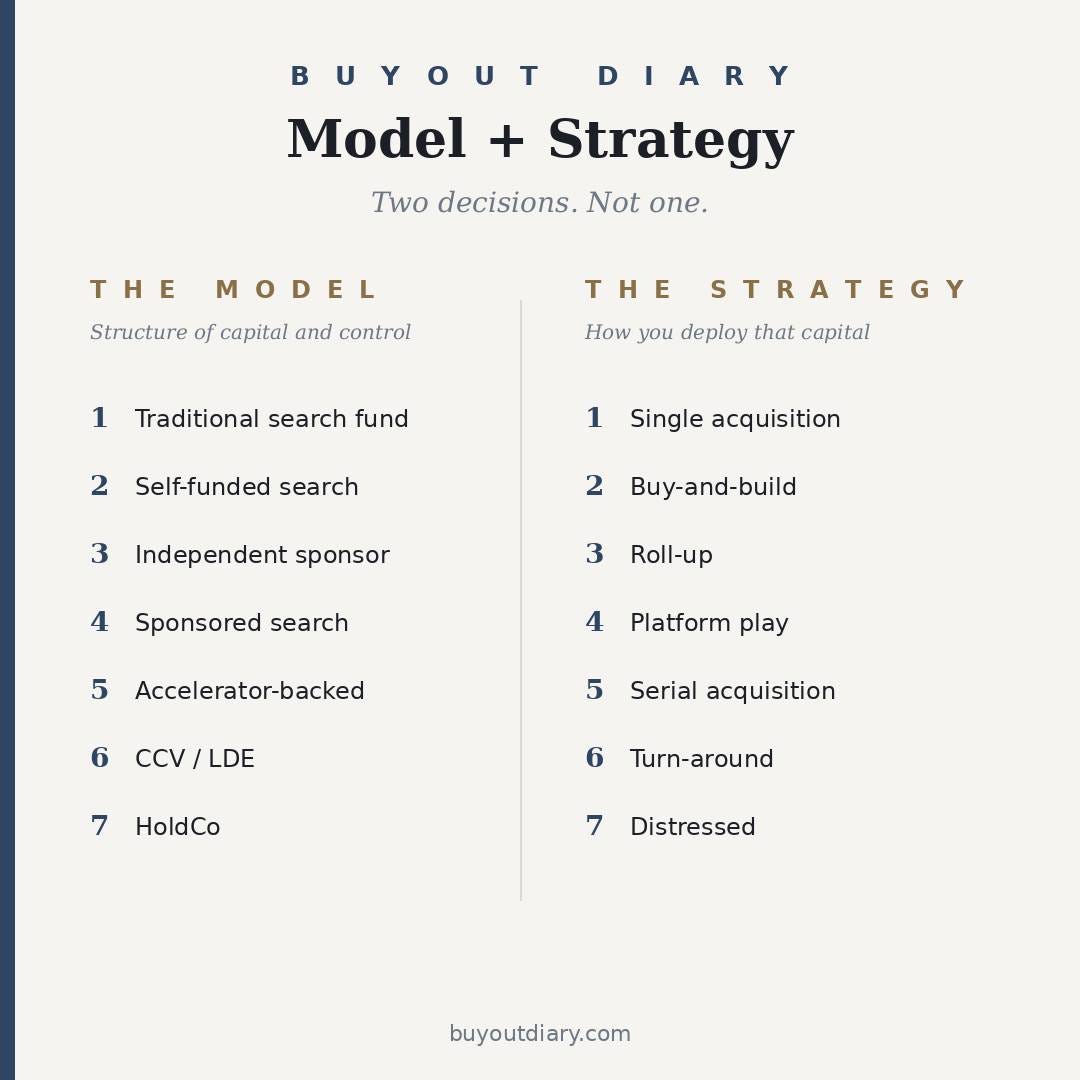
The models, previewed
Seven models, one line each. This is the map I wish had existed when I started searching.
Traditional search fund. Investors back you upfront for 18 to 24 months to search. You become CEO post-acquisition. Classic Stanford model.
Self-funded search. You fund the search yourself. You negotiate alone. You own more equity. You take personal financial risk.
Independent sponsor. You identify a deal before raising the equity to acquire it. Investors back the specific transaction; your ownership, operating role, and economics are negotiated deal by deal.
Sponsored search. A PE firm, family office, or other lead sponsor backs your search. The sponsor may provide capital, guidance, and acquisition support, with involvement and decision rights depending on the agreement.
Accelerator-backed search. An accelerator provides capital, playbooks, and operational support. Less autonomy than self-funded, more structure and guidance.
Committed capital vehicle and long duration enterprise (CCV/LDE). Investors commit capital to a vehicle intended to pursue acquisitions over a longer period. The amount raised upfront, deployment rights, ownership structure, and expected hold period differ between vehicles.
HoldCo. You build a company that owns businesses over time, using your own capital, outside capital, cash generated by existing businesses, or a combination. A prior exit can help fund it, but is not required.
The order in the series is deliberate, and different from this list. Traditional search fund runs first because it is the reference model everyone compares against. Self-funded second because that is the model most European searchers actually end up in. The rest follow in the order that best teaches each successive distinction.
The strategies, previewed
Two strategy pieces in the series, placed where they earn their place.
Single acquisition, own-and-operate. The default strategy for most models. Buy one business, run it for years. The piece will run after traditional search fund and self-funded because those two models default to single acquisition and readers benefit from understanding the strategy deeply before moving on.
Portfolio strategies: buy-and-build, roll-up, platform play, serial acquisition. Four strategies compared in one piece. Only becomes available in practice with the committed capital models and the HoldCo. Will run after the CCV and LDE piece.
Plus one strategy-adjacent piece on turn-around and distressed acquisitions. Higher risk, narrower audience, but real. Will run near the end.
What each piece will do
The framework each model piece follows, so you know what to expect and can compare across the series.
What the model is. Structure, key features, how it differs from adjacent models.
Who it fits. Capital position, experience, timeline, temperament, ambition.
What it costs. Capital required, time to close, opportunity cost, personal exposure.
What control looks like. Investor relationships, board dynamics, decision autonomy.
How it ends. Exit pathways, hold periods, what success and failure both look like.
Real European examples where possible. Named or anonymised depending on the model and the practitioners.
The honest downside. Where the model breaks, who it hurts, and what to watch for.
Every model piece follows this framework. The comparability is the value.
The pieces are designed to stand on their own, so you can read the model that matters to you and return to the others when you need them.
The order and the arc
The series runs across the coming weeks, with one piece per Monday.
Intro (this issue)
Traditional search fund
Self-funded search
Single acquisition (strategy)
Independent sponsor
Sponsored search
Accelerator-backed search
CCV and LDE
Portfolio strategies
Turn-around and distressed
HoldCo with committed capital
How to choose (the synthesis)
This issue is the index for the series. I will add links to the titles as the pieces become available, so you can return to it whenever you want to compare the models and strategies.
Why this series, why now
European ETA is at a specific moment in its cycle. The 2026 Stanford Search Fund Study just released, showing the American market saturating and the European market opening. The IESE 2024 International data confirms the same divergence. Spain has built a mature ETA ecosystem over the past decade. Every other European country is at least five years behind.
The succession gap in Europe is real and it is not filling itself. Family-owned SMEs across Germany, France, Italy, the Netherlands, and Belgium are approaching succession without ready internal candidates. That opens the door to acquisition entrepreneurs. Not just to searchers. Also to investors, family offices, and operator communities who want to participate in the transition.
A searcher building a thesis in the next twelve months faces more choice than any European ETA cohort before them. New models like the LDE have just been named and formalised. Independent sponsor is gaining traction. Accelerator infrastructure is emerging. Traditional search fund is more accessible than it was five years ago. Choosing well matters more when the options have multiplied.
Investors face the same question from the other side. Which model should I back. Which strategy should I support. The series is written for both angles.
That is why this series is happening now. Not because I have all the answers. Because the choice deserves a framework, and no one else is publishing one for the European market.
What you can do this week
Three actions scaled by ambition.
Smallest step. Bookmark this issue as the index for the twelve-week series. Return to it when you need to remember what comes when.
Bigger step. Reply with your best guess at which model you might land on. The guess does not have to be right. Naming it now makes the series a personal exercise, not a general read.
Boldest step. If you are already searching, share this issue with one investor or one operator in your network who will benefit from the same clarity. The series builds better with more European practitioners in the conversation.
Close
A reference for searchers, investors, and operators making the choice. Start with the model you are considering, then come back as your thinking changes
Where I sit today: a hybrid between independent sponsor and self-funded search, with a HoldCo as the long-term ambition. That is the honest position, and it will shape how I write each piece in the series. Readers who are in a similar hybrid state should feel the pieces speak to them directly. Readers who are settled on a specific model will still get the framework laid out cleanly.
See you next Monday. The traditional search fund is where we start.
Alexander