

This is the final issue in the Luxury Lessons series. If you have followed along across Parts 1, 2, and 3, you already know how Arnault acquired BVLGARI, how he integrated it, and how he closed Tiffany at $425 million below the original price after the COVID-driven legal standoff. Each issue is in the archive if you want the full context.
This issue is about what Arnault did with Tiffany once it was his.
The first two years were extraordinary. Record revenues, record profits, the highest-performing single-brand store in all of LVMH after the Fifth Avenue flagship reopened. Then the picture became more complicated. By 2023, Tiffany was losing market share to Cartier. By 2024, revenue had begun to decline in certain quarters. Arnault himself acknowledged that the integration would take time.
This is the honest version of the Tiffany integration. The triumphs and the limits, the playbook applied at scale and the moments where it has not yet produced what was promised.
1. The Post-Acquisition Test
The deal closed on Thursday 7 January 2021.
By the end of the same day, three of LVMH’s most senior executives had been placed across every strategic function of the acquired business. Before the new owner had even had a chance to read his own welcome email.
CEO Alessandro Bogliolo was out. In his place: Anthony Ledru, who had spent years as Executive Vice President of Global Commercial Activities at Louis Vuitton, and who had previously served as Senior Vice President of North America at Tiffany itself. He was the rare candidate who understood the brand from the inside and the LVMH operational model from the outside. Same day, Chief Artistic Director Reed Krakoff and Chief Brand Officer Daniella Vitale departed.
Arriving alongside Ledru: Alexandre Arnault, Bernard’s son and former CEO of Rimowa, appointed Executive Vice President of Products and Communications. And Michael Burke, Chairman and CEO of Louis Vuitton, appointed Chairman of Tiffany’s board.
This was not a panic move. It was a planned move. The leadership decisions had been made long before the deal closed, sitting in a folder somewhere in LVMH’s Paris headquarters waiting for the day they could be executed.
The signal to Tiffany’s organisation was unmistakable. This was not a financial acquisition. It was a strategic absorption. The brand was being repositioned within the LVMH portfolio, and the people who would lead that repositioning were already chosen.
The ETA parallel: What Arnault demonstrated on day one is that the leadership decisions that follow an acquisition should be made before the deal closes, not after. Most first-time buyers leave the post-acquisition leadership question for after closing because they want to “get to know the team first.” That sounds reasonable but it produces months of drift while the acquired business waits to see what is going to happen. The buyer who has already worked out who is staying, who is going, and who will fill the gaps walks into the first week with a plan. The buyer who has not signals indecision at exactly the moment the team is most receptive to direction. Decide before you sign.
2. Governance Reset
The most immediate question any post-acquisition leadership team faces is what to do with the existing CEO. Replace or retain. The decision determines the speed and character of everything that follows.
Arnault’s calculation in this case ran on three considerations.
The first was Bogliolo’s profile. He had been CEO since 2017, brought in from Diesel by Tiffany’s previous board specifically to drive a turnaround that the board judged was not progressing fast enough. He was already a transitional figure rather than a continuity figure when LVMH arrived. He was a capable executive with luxury experience, but he was not a builder of Tiffany’s heritage. He had no deep institutional memory of the brand, no decades-long supplier or customer relationships that depended on him personally, no irreplaceable role in the brand’s identity. The transition risk of removing him was modest.
The second consideration was the strategic gap. Tiffany’s challenges, as we covered in Part 3, were not heritage problems. They were positioning problems. Product range was anchored in accessible silver. Customer base was ageing. Online and Asia were underdeveloped. These were transformation challenges, not stewardship challenges. They required a leader with the energy and authority to drive significant change rather than a leader whose value was in continuity.
The third consideration was the candidate available. Anthony Ledru was an unusual fit. He had been at Louis Vuitton long enough to be fluent in the LVMH operational model. He had been at Tiffany earlier in his career, which gave him genuine credibility with the existing organisation rather than the resented status of a complete outsider. He understood luxury jewellery distribution, having run the commercial side of Louis Vuitton globally. And he was at the right point in his career to take the Tiffany seat as the defining role of his professional life.
The decision to replace was the right one for Tiffany specifically. It would have been the wrong decision for a different acquired business with different conditions. The lesson is not that fast leadership change works. The lesson is that the answer depends on what kind of value is at risk.
The appointment of Alexandre Arnault as Executive Vice President of Products and Communications carried a separate signal. Bernard’s son arriving at Tiffany was not just an organisational decision. It was a generational one. The Tiffany integration was being treated as a long-term project that would outlast the current generation of LVMH leadership. That signal mattered to investors, to the LVMH organisation, and to Tiffany’s senior team. The brand was being treated as something the family intended to hold for decades.
The ETA parallel: The replace-or-retain decision rests on three questions every acquirer can ask of the businesses they look at.
What kind of value is this leader actually creating, continuity or transformation?
What will the institutional cost be of removing them, and is there a credible replacement available?
And what message does the decision send to the rest of the team that will live with the consequences?
At SME scale the same logic applies. A founder running a service business who personally holds the supplier relationships and customer trust is a continuity figure who needs to be retained or transitioned carefully. A managing director hired four years ago to drive a turnaround that has stalled is a transitional figure already, and replacing them carries less risk than first-time buyers usually fear.
3. Brand Repositioning
Pre-acquisition Tiffany was a brand caught between affection and irrelevance. Customers respected it. They did not desire it. The blue box was iconic. Audrey Hepburn was iconic. The accessible silver bracelets were a coming-of-age gift. And none of that was producing the growth a $15.8 billion acquisition required.
The repositioning that followed in 2021 and 2022 was the most aggressive brand intervention LVMH had ever undertaken on an acquired business.
The signature move was the About Love campaign launched in August 2021. Beyoncé wearing the Tiffany Yellow Diamond, only the fourth time in 144 years it had been worn publicly. Jay-Z alongside her. The campaign drew controversy, attention, and a fundamental shift in how the brand was perceived. Tiffany was no longer a heritage jeweller selling silver to bridesmaids. It was a brand that could put the Tiffany Yellow Diamond on Beyoncé.
The campaigns that followed extended the repositioning, and each one was chosen with strategic precision rather than as a generic celebrity activation. Pharrell signalled to the streetwear-luxury crossover that has driven so much of the category’s growth. Rosé from Blackpink signalled to the Asian market where Tiffany’s growth had been underweighted for years. Anya Taylor-Joy and Tracee Ellis Ross signalled to the cinema-cultural class. Eileen Gu signalled to the Chinese consumer specifically. Sarah Jessica Parker brought the multi-generational legitimacy of Sex and the City. Each ambassador was a targeted demographic move, not a publicity moment. The cumulative effect was to give Tiffany a presence in cultural conversations it had been excluded from for a decade.
Product strategy moved in parallel. The Lock collection, launched in 2021, became an immediate bestseller and signalled the new product direction: higher price points, statement pieces, less reliance on entry-level silver. A men’s jewellery line was introduced. High jewellery, the most profitable category in the industry, received significantly more investment.
The most visible commitment was physical. The Fifth Avenue flagship, Tiffany’s most important retail asset, was closed for the entire 2021 calendar year for a renovation that ultimately cost more than $500 million. When it reopened in April 2023 as The Landmark, it was no longer simply a flagship store. It was an experience, a destination, a statement that LVMH was prepared to invest at a scale Tiffany had never previously commanded. Within months of reopening, it became the highest-performing single-brand store in the entire LVMH portfolio.
Heritage was not abandoned in any of this. It was selectively activated. The Vision and Virtuosity exhibition at Saatchi Gallery in London in summer 2022 deployed the brand’s full historical archive in a museum-quality presentation. The message was that Tiffany had a heritage worth taking seriously, and that LVMH was the steward equipped to honour it while also dragging the brand into the present.
This was brand repositioning at the absolute upper limit of what is possible for an acquirer to attempt. Few companies in luxury could have funded it. Fewer still would have committed to it on the timeline LVMH did.
The ETA parallel: Brand repositioning at SME scale rarely involves Beyoncé, but the principle is identical. A small business that has stopped attracting new customers usually has not stopped because it became worse. It has stopped because the world around it has changed and the brand has not moved with it. The plumbing business that built its reputation in 1995 and has not updated its website, its quoting process, or its customer language in twenty years is in the same position Tiffany was in 2019. The work is not invention. It is targeted modernisation that takes the existing equity of the brand and translates it into terms the current customer recognises. That work is funded out of the cash flow the business already produces. It is not glamorous and it is not optional.
4. Financial Outcomes: The Record Years and the Headwinds
The first two years produced results that exceeded what even Arnault had projected.
2021 was a record year for Tiffany despite the Fifth Avenue flagship being closed for renovation throughout. Operating income exceeded $900 million, a figure that, as Arnault noted at the time, “handsomely beat its absolute records for both revenue and profitability.” LVMH’s group cash flow for the year reached €13.5 billion, more than double the previous record. “In 2021,” Arnault said, “we invested €13.3 billion, almost entirely to acquire Tiffany.” The phrasing was deliberate. The acquisition was being framed as the most consequential capital allocation decision LVMH had made.
2022 confirmed the trajectory. High jewellery sales doubled. The Lock collection became the bestselling launch in the brand’s recent history. Asian growth, which had been a strategic objective from the outset, accelerated meaningfully. By the time the Fifth Avenue flagship reopened in 2023, annual revenue had increased by approximately $1.5 billion since acquisition.
And then the picture became more complicated.
Industry data showed Tiffany losing global branded luxury jewellery market share by approximately 0.7 percentage points in 2023, with revenue estimated to decline approximately 3% year on year in Q2 2024. Cartier and other Richemont brands were growing faster. Senior staff turnover at Tiffany accelerated. The market share losses were partly attributable to a broader luxury slowdown, particularly in Asia, that affected most jewellery brands. But Tiffany’s underperformance relative to its closest competitor was not solely a market story.
Arnault addressed this directly in interviews through 2024. “I’m very confident about Tiffany, but it takes time,” he said. The phrase carried the implicit acknowledgement that the original integration timeline had been ambitious, and that the work of fully repositioning a 188-year-old brand was not going to be completed in three years.
This is the more complicated chapter of the integration. Two record years, then a slowdown that does not unwind any of what came before. The capital deployed has not been wasted. The brand has been genuinely modernised. But the compounding has slowed, the competition has not stood still, and the limits of even the best integration playbook are visible in the numbers.
The honest framing is that the Tiffany integration is four years old. The BVLGARI integration was four years old in 2015. Looking at BVLGARI in 2015 would have given you only a partial view of what the brand would become by 2025. Tiffany deserves the same patience, but it also deserves the honesty that not every quarter so far has met the bar set by 2021 and 2022.
The ETA parallel: Acquisition outcomes do not arrive in straight lines, and the buyer who is honest about that produces better long-term decisions than the buyer who is not. The first two years after an acquisition often produce the most visible gains because the obvious operational improvements are made first. Years three to five are often harder, because the easy wins are already done and the structural issues that remain require more capital, more time, and more patience to solve. Building a financial plan that anticipates that S-curve, rather than assuming linear improvement, is one of the most important pieces of preparation a first-time buyer can do before closing. The numbers are going to wobble. That is normal. Plan for it.
5. Long-Term Integration Logic
What Tiffany now represents within LVMH is structurally different from what BVLGARI represents.
BVLGARI is the artisan anchor. Italian heritage, Roman identity, the Valenza manufacturing facility growing towards 1,600 artisans by 2029. The brand’s strategic role is to embody the craft, the tradition, the European luxury jewellery lineage. Its growth is driven by the depth of that positioning.
Tiffany is the geographic and cultural anchor. American heritage, US market dominance, the Fifth Avenue flagship as both the highest-performing store in the LVMH portfolio and the symbolic centrepiece of the brand. Its strategic role is to give LVMH genuine ownership of the United States luxury market, a position the group has historically underweighted.
The two brands serve different customers in overlapping geographies without directly cannibalising each other. A Tiffany customer is not deciding between Tiffany and BVLGARI. They are buying into specific cultural narratives that each brand owns separately. That portfolio architecture is the strategic logic that makes Tiffany’s integration valuable to LVMH even when individual quarters underperform.
The Watches and Jewellery division, which was 9% of LVMH’s revenue when Arnault made his move on Tiffany in 2019, is now a structurally different business. It has scale, geographic reach, brand portfolio diversity, and a depth of operational infrastructure that no competitor matches. That is the longer-term outcome the Tiffany acquisition was designed to produce, and it has been produced regardless of any individual year’s headlines.
The work that remains is closing the gap to Cartier. Tiffany’s underperformance against its closest competitor is the single most important issue facing the integration in the coming years. It is not a problem of capital. It is not a problem of strategic intent. It is a problem of execution against a competitor that has been refining its model for longer.
That problem is solvable. It will not be solved quickly.
The ETA parallel: Portfolio thinking is the most underused concept in self-funded acquisition. Most first-time buyers approach their first deal as a standalone bet, then start thinking about the second deal only after the first has stabilised. The buyers who build the most durable HoldCos think about deal one, deal two, and deal three together from the beginning. Each acquisition should sit in a different position relative to the others, serving a different customer segment, geography, or capability, so that the portfolio is genuinely complementary rather than a collection of separately purchased businesses. That logic is what turns a series of acquisitions into a HoldCo with strategic value rather than a balance sheet with several unrelated SMEs on it.
6. Final Lessons
This series has covered four issues, two acquisitions, fourteen years, and approximately $20 billion in transactions. The lessons that travel down to the kind of deals most readers of this newsletter are working on are not the obvious ones about scale or capital. They are about how Arnault thinks, and what that thinking can teach acquisition buyers operating at any size.
Acquisitions are bets on what a business can become, not what it currently is. Arnault has paid premiums on every deal in this series because he was paying for the gap between current performance and potential under his stewardship. The valuation logic only works if you have an honest view of what the business could be and the operational capability to get it there. Without both, the premium becomes irrational.
Integration is the work, not the deal. The deal closes one chapter. The integration writes the rest of the book. Arnault has spent more time, capital, and senior leadership attention on what happens after closing than most acquirers spend on the entire deal process. That allocation is the difference between a good investment and a great one.
Integration speed depends on what kind of value is at risk. Some businesses need to be left alone to keep producing what made them worth acquiring. Others need active intervention to unlock what has been sitting dormant. The judgement about which the situation calls for is more important than any preference for patience or aggression as a default mode.
Acquiring legacy businesses requires patience and humility. A long-term stewardship mindset. Governance that supports creativity without micromanaging it. Continuous reinvestment in identity. None of this is glamorous. None of it is what financial engineering optimises for. All of it is what makes legacy businesses worth owning across decades rather than across quarters.
The greatest acquirer in the world still has limits. Tiffany is not yet what Arnault paid for it to become. The integration is succeeding by most measures and falling short by some. That honesty matters because it is what most acquisition coverage avoids. Real acquisition outcomes do not arrive in straight lines. The buyers who plan for that produce better long-term results than the buyers who do not.
7. Building something I wish had existed when I started
Last July I hosted my first ever ETA Europe meetup in Amsterdam. I had no idea if anyone would show up.
They did. And after five meetups in Amsterdam, something shifted. The room started to feel like a community. People who had been exploring acquisition entrepreneurship alone, often for months, suddenly had a group of people who understood exactly what they were going through.
That feeling, of not being alone in this anymore, is what keeps me doing it.
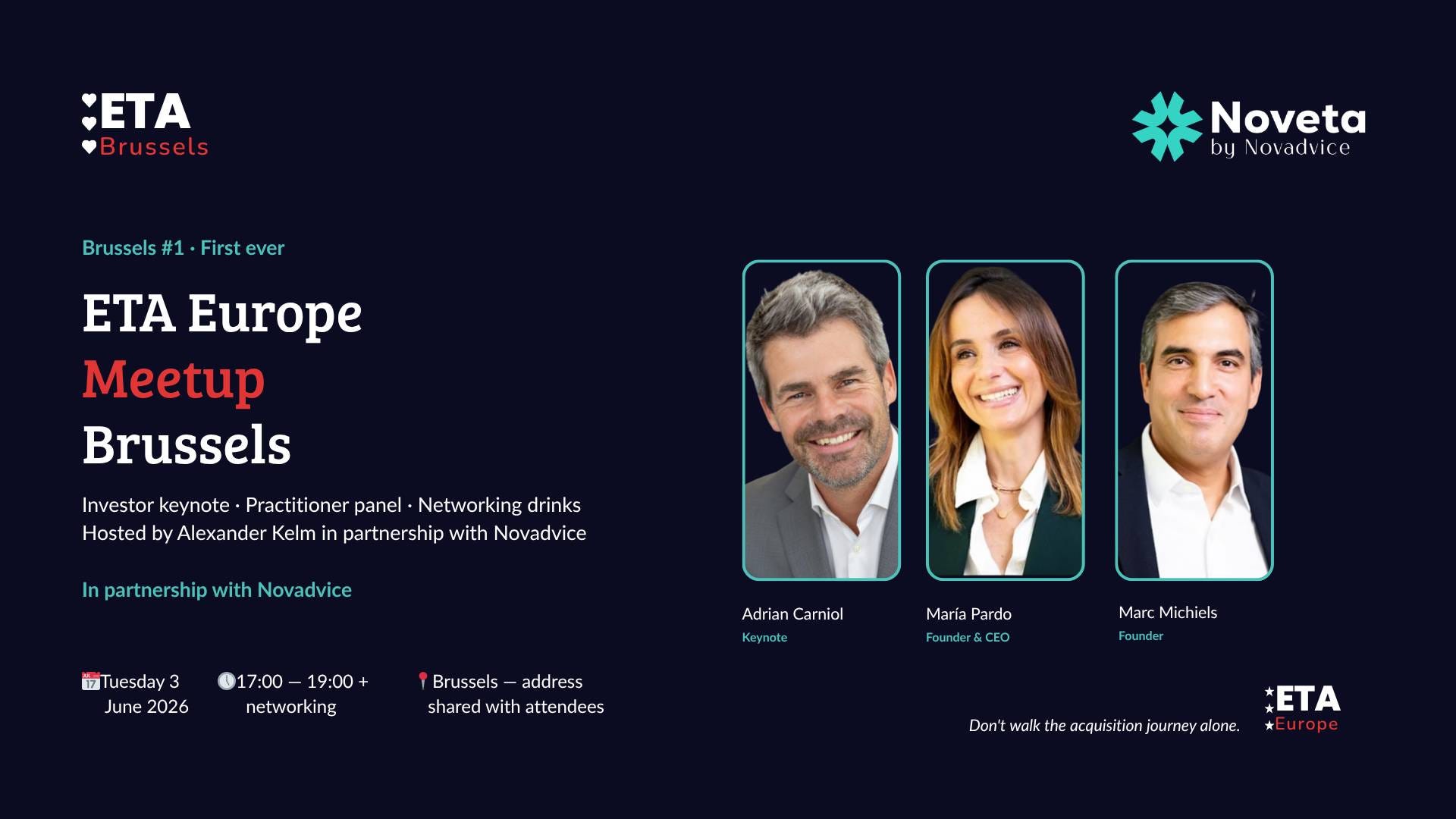
Belgium felt like the obvious next step. Thousands of owner-operated SMEs, an ageing generation of founders ready to sell, and almost no community for the people thinking about acquiring them. That is exactly the kind of gap ETA Europe exists to fill.
So on Wednesday 3 June, we are hosting the first ever ETA Europe meetup in Brussels, in partnership with Novadvice, one of Belgium’s leading SME acquisition boutiques.
The evening will include:
An investor keynote with Adrian Carniol from Novadvice on what he looks for in searchers and how he structures deals
A practitioner panel with Charles d’Ursel (currently searching), Alexandre Guyenne (acquiring), and Marc Michiels, co-founder of Novadvice
An open Q&A
Networking and drinks to close
If you are somewhere in the early stages of this journey and want to be in a room with people who genuinely get it, this is for you.
If you are based in Belgium, the Netherlands, France, or anywhere within reach, I would love to see you there.
The first 20 tickets are €35, then €50. Only 60 seats.
That is the end of the Luxury Lessons series.
Thank you for reading along. Many of you have replied to issues across the four parts with sharp questions, real corrections, and your own experiences from deals you have done or are working on. Those replies have shaped how I think about this material, and several of them will inform future issues.
Hit reply and tell me: which of the four issues in this series gave you the most useful insight, the BVLGARI deal, the BVLGARI integration, the Tiffany deal, or the Tiffany integration?
See you next Monday.
Alexander